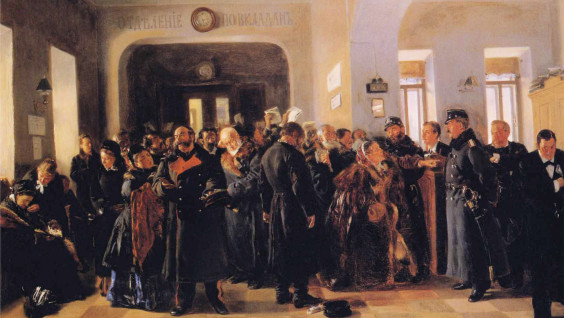
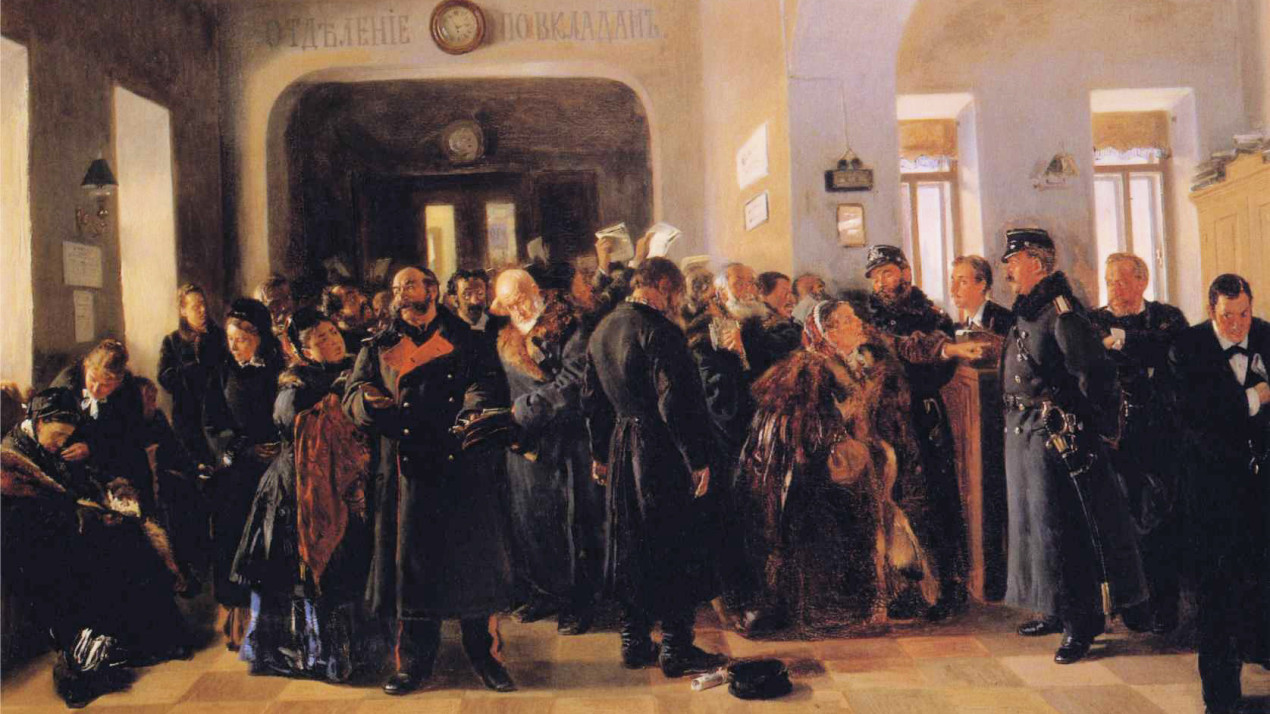
Painting "Bankruptcy", Vladimir Makovsky. Photo: https://ru.wikipedia.org
December 13 marks the 200th anniversary of the birth of a prominent figure in the field of economics, who had a significant impact on the development of the financial sector in our country. He managed to do this thanks to close cooperation with the Geographical Society, which he joined in 1850.
Evgeny Lamansky was, one might say, destined to become a financier — his grandfather also served in a state-owned loan bank. His father, who later joined the Ministry of Finance, also began his career there. On the maternal side, there were also representatives of the profession: the uncle was the director of a department in the same Ministry of Finance.
His parents provided a very decent education for their progeny — after high school he entered the Tsarskoye Selo Lyceum. Already there, the young Lamansky developed a peculiar hobby: he studied the history of domestic money circulation. He was helped in this by a classmate, who inherited from his father a library that kept the «Complete Collection of Laws of the Russian Empire.» The family library also provided the young man with rich food for thought. There he found numerous financial reports: orders from the public charity, loan and widow’s treasuries, etc.
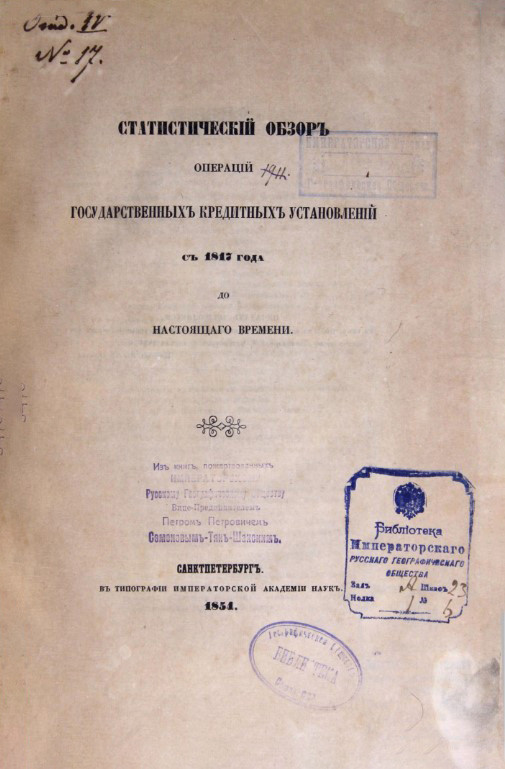
Eventually, Lamansky’s passion resulted in two articles, the publication of which became possible thanks to the financier’s activities at the Imperial Russian Geographical Society. After joining the IRGS, he began managing its library, became secretary of the statistics department, and then secretary of the organization as a whole. He was also responsible for the editorial office of the statistical collection of the Society. It was there that his works were published in 1854: «A Historical Outline of Monetary Circulation in Russia from 1650 to 1817» and «A Statistical Overview of the Operations of State Credit Institutions from 1817 to 1852.» For them, he received the Zhukovsky Full Award from the Russian Geographical Society.
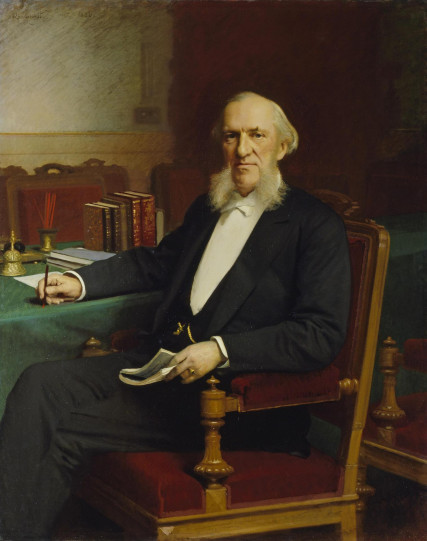
Evgeny Lamansky. Photo: https://ru.wikipedia.org
A year later, in 1855, the IRGS Council decided to send Evgeny Lamansky abroad as a representative of the Society at the III International Statistical Congress in Vienna and to establish contacts with foreign scientists. The young financier also hoped to study how the financial business was set up in Europe. However, there were problems at the main job.
After graduating from the lyceum, Lamansky initially served in the State Chancellery, from there he soon moved to His Imperial Majesty’s Own Chancellery, and in 1853 he became an official with special assignments in the Ministry of Finance. When it came to a long-term business trip abroad, his immediate superior, Finance Minister Pyotr Brok, unexpectedly opposed this. He emphatically stated that there was nothing to study abroad, and refused to allocate funds for the trip.
The business trip took place thanks to the chairman of the Geographical Society, Grand Duke Konstantin Nikolaevich. True, Lamansky had to leave the ministry, but this did not bother him. For a year and a half, from the spring of 1857 to the autumn of 1858, he combined meetings on behalf of the IRGS with foreign scientists in the field of geography, physics, statistics and his own plans to study the financial institutions of Germany, France, Belgium, Austria, and Great Britain. In particular, in Paris, where Lamansky spent the winter, he went to the Bank of France every day, trying on different positions, since the local authorities provided him with such an opportunity. The financier summarized the results of his research in his work «The Current Situation of Credit Institutions in Europe and America and Their Relationship to Industrial Enterprises,» which was published by the «Russkiy Vestnik» magazine.
Upon returning to his homeland, Lamansky hoped to return to the ministry. By that time, Aleksandr Knyazhevich had become minister, and there was talk that he was interested in such an employee. But then politics intervened. In his younger years, Lamansky attended Mikhail Petrashevsky’s circle a couple of times. The very same circle the activities of which led to Fyodor Dostoevsky being sentenced to death (fortunately, later overturned), along with 20 other members of the organization. Evgeny Lamansky was then interrogated and safely released — unlike his brother Porfiry, he did not show much interest in the activities of the circle and did not express dangerous ideas from the point of view of the authorities. Perhaps no one would have remembered this, but while in England, the financier, along with friends, visited Aleksandr Gerzen, who lived there, which became known to Emperor Aleksandr II.
As a result, Lamansky did not get into the Ministry of Finance, but got a job in the Ministry of State Property, headed by Mikhail Muravyov. He was the vice-chairman of the IRGS and personally vouched to the tsar for Lamansky. And then, almost immediately, he sent a new subordinate to take part in the work of the finance commission, which, along with several others, was responsible for preparing reforms for the liberation of peasants.
After the Crimean War, which severely disrupted the Russian economy, Lamansky dealt with the transformation of the banking system, worked at the State Bank, introduced a check system, and the principle of cash unity, organized a school for accountants, and carried out many more reforms, which eventually significantly affected the country’s financial system.