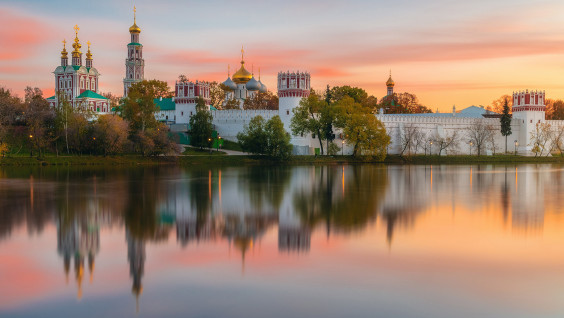

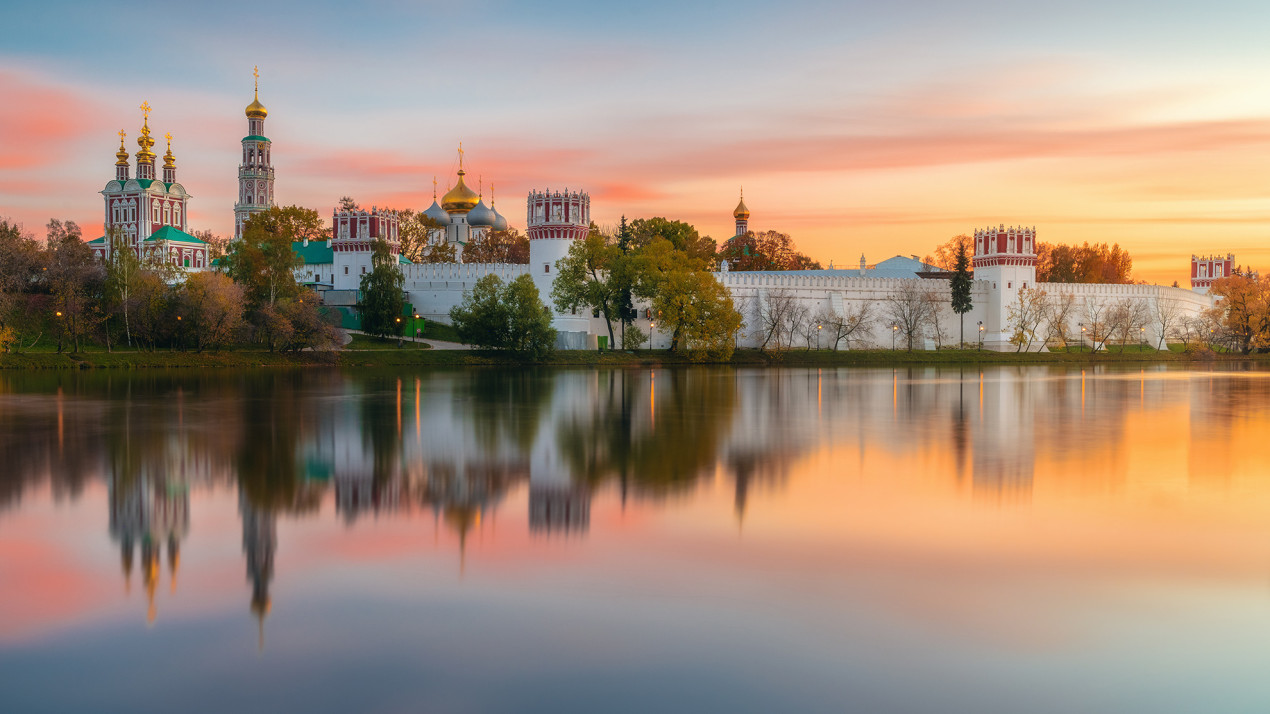
Novodevichy Monastery. Photo: Sergei Sadov, participant of the RGS's contest "The Most Beautiful Country"
The RGS Award in the category «Best Historical and Cultural Project» went to the exhibition «Novodevichy Monastery: Milestones of History». It was prepared in honor of the anniversary of the monastery, which turned half a thousand years old in 2024–2025. We asked the curator Olga Sokolova how to create a «time machine» with the help of ancient artifacts and modern technologies, allowing visitors to fully experience the atmosphere of different centuries.
Portal to the past
«One of the attractive aspects of our profession is that we are deeply immersed in the topic we are working on, » says Olga Sokolova. «Our task is to see the exhibition through the eyes of a visitor and understand how best to reveal a particular historical plot. The exhibition was created by a small group of authors, which included Marina Shvedova, a specialist in the history of the Novodevichy Monastery, the curator of its collection at the Historical Museum and the author of numerous scientific papers, as well as my colleague Lyudmila Savchenkova, an experienced curator at our museum. We selected the exhibits and created a scenario with their help, figured out how to make it engaging and as informative as possible.»
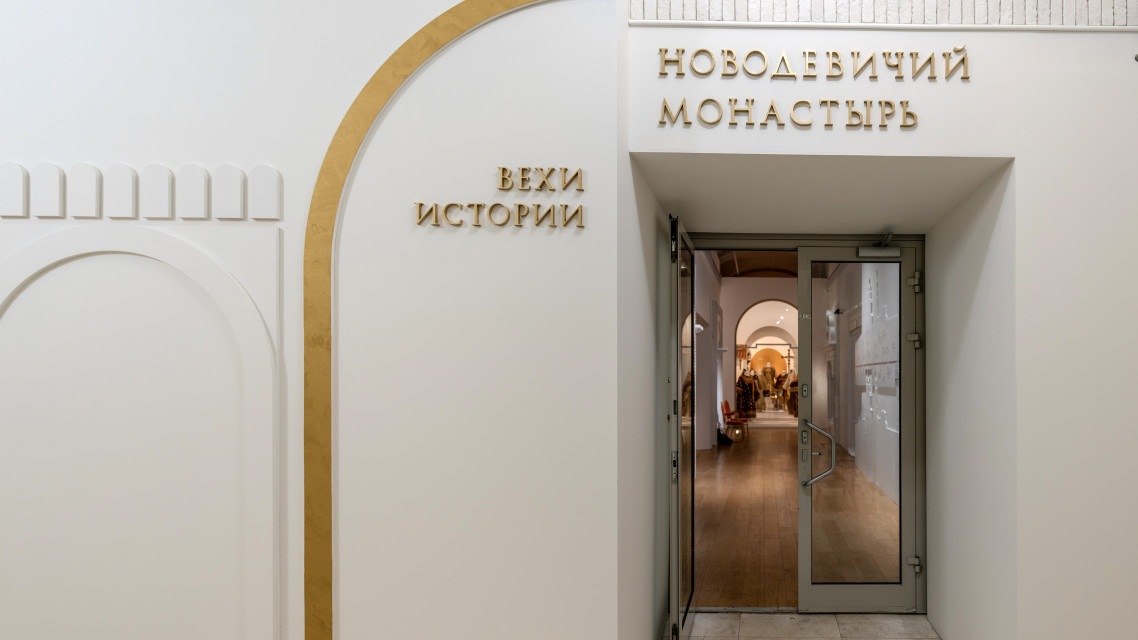
Welcome to the exhibition "Novodevichy Monastery: Milestones of History". Photo: Sergei Militsky
Here is an example of how it works. The story of the Miloslavsky tsarevnas imprisoned in the monastery is closely connected with the Streltsy uprising. And at the entrance to the hall leading to their cells, visitors were greeted by a unique object that has been preserved since those times: a cast-iron plate on which the sentence of the Streltsy was stamped. Such plates were mounted on steles, which were erected on all major roads leading from Moscow, and gallows with executed rioters were placed nearby. At the exhibition, the curators placed an audio speaker by the plate, and visitors could hear the impressions of the Novodevichy Monastery of the Hanoverian diplomat Friedrich Christian Weber, who visited both capitals of Russia in 1714–1719 and made detailed notes about it in his diaries. However, he did not manage to get into the monastery itself, because «His Tsar Majesty’s half-sister, Tsarevna Sofia, who was involved in the former rebellion, lived and was buried there,» so «no one was allowed there without the special permission of the then vice-tsar of Moscow, Prince Fyodor Yuryevich Romodanovsky.» The overseas traveler had to limit himself to the exterior of the monastery.
«This monastery lies on a beautiful plain, and it offers a view of the surrounding countryside. There are three hundred nuns who live very strictly and never leave the monastery; on holidays, they enjoy only one pleasure: they walk along the large stone wall surrounding the monastery. <…> In the described Devichy Monastery, I was shown on the wall surrounding it the room in which Tsarevna Sofia was kept at the beginning of her imprisonment and from which she had to watch the execution of the rebels who were hanged in front of her window. She lived for fifteen years in this monastery, and one day, remembering her, the tsar expressed such an opinion about her that if it were not for her thirst for rule, she would have been a perfect tsarevna in her physical and spiritual talents.»
From the diary of Friedrich Christian Weber
«We wanted to immerse the visitors in a particular era when entering a particular hall,» explains Olga Sokolova. «The audio accompaniment made it possible to make the narrative more multifaceted, to add to it the 'voices of that time’. We asked our colleagues to voice the quotes selected for the exhibition, and although they are not professional actors, it turned out very vivid. And they themselves enjoyed it — it’s an opportunity to touch the era, to feel themselves in it. Their emotions were transmitted to the visitors, because we perceive the world with different senses, and the more we use them to create an exhibition, the deeper visitors will be able to immerse themselves in the past.»
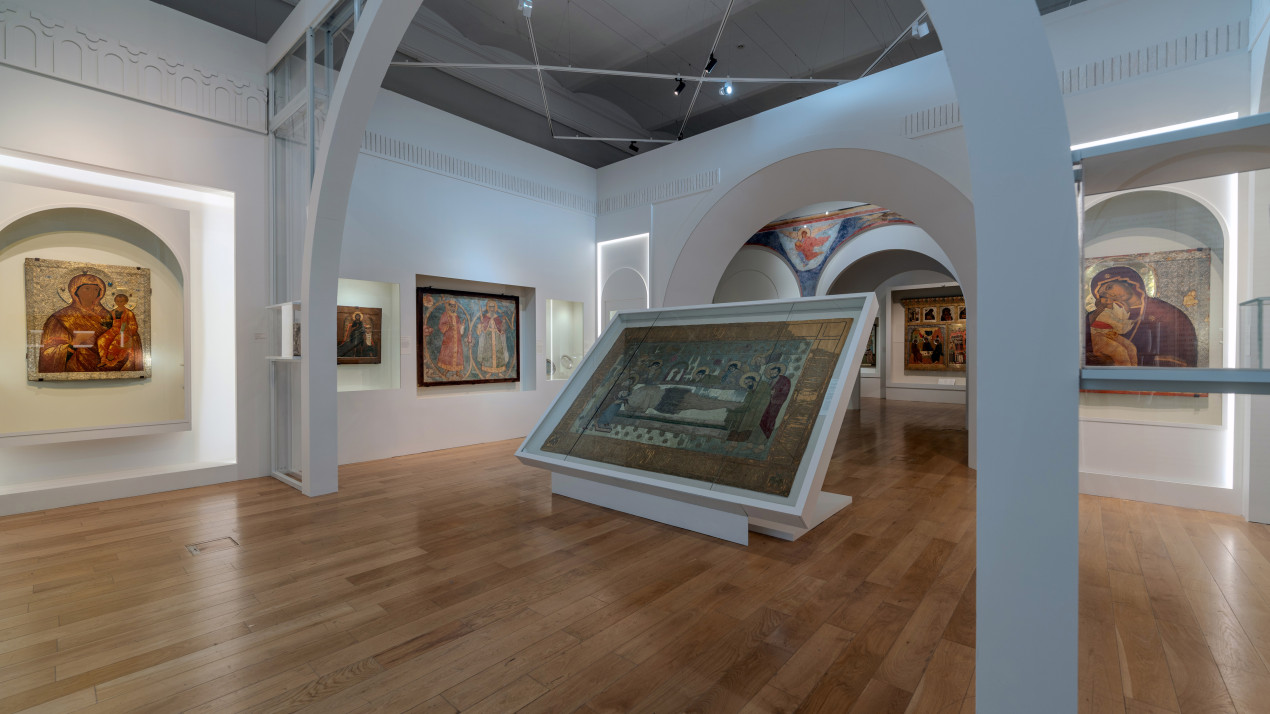
It was also a difficult task to convey the changes that have taken place over the centuries in the monastery’s architecture. If architectural forms are actively presented in the exhibition, they will attract all the attention, distracting from the main thing — authentic objects that have come down to us from the depths of time. The artist Ekaterina Antonova managed to find a solution so that, immersing those present in the monastery’s history, they could organically lead them from one exhibit to another.
Entrance to the first section of the exhibition. Photo: Sergei Militsky
«She works very delicately with architectural forms, » Olga Sokolova notes. «In some places she’ll introduce an arch or a half-arch, in others, she’ll introduce architectural details characteristic of the era. This way, she very subtly captured the early era and the very beginning of the monastery’s history. The fact is that its archive burned down at the end of the 16th century, presumably during the fire of 1571, when the Crimean Khan Devlet Giray attacked Moscow. Only two documents tell about the early history of the monastery: the spiritual charter of the Grand Duke of Moscow Vasily III and the spiritual charter of Elena Devochkina, the first abbess of the monastery. Therefore, researchers have many questions about the buildings of that period. And the artist suggested transparent, contoured walls with a very light portal. Through it we enter the first section of the exhibition, dedicated to the era of Ivan the Terrible and his son, Tsar Fyodor Ioannovich. At that time, the Smolensky Cathedral, the main temple of the monastery, was built. Here, the artist decorated the space with recognizable architectural details, delicate arches, and introduced mural elements.»
The Smolensky Cathedral is one of the unique monuments that have completely preserved their wall paintings of the end of the 16th century. And to demonstrate the translucency of the frescoes, the exhibition developers used a complex technological technique — printing on glass. Gradually, visitors moved towards the huge bright spaces of the time of Tsarevna Sofia, during which the monastery received the architecture we are familiar with. Here Ekaterina Antonova used elements typical of Baroque churches, and the small spaces with arched niches in the walls reminded of the imprisoned Miloslavsky tsarevnas. Sections (rooms) resembling cramped monastic cells have become a place for displaying objects that once belonged to them.
«To talk about architecture in more detail, we came up with the following move, ” Olga Sokolova shares the details. "We have preserved in our collections a painting from the 1770s, which depicts the layout of the monastery at that time. We put it in the exhibition, and next to it we put a large screen with an image of the painting, which allows us to interactively select an object and read a reference or a story related to a particular building."
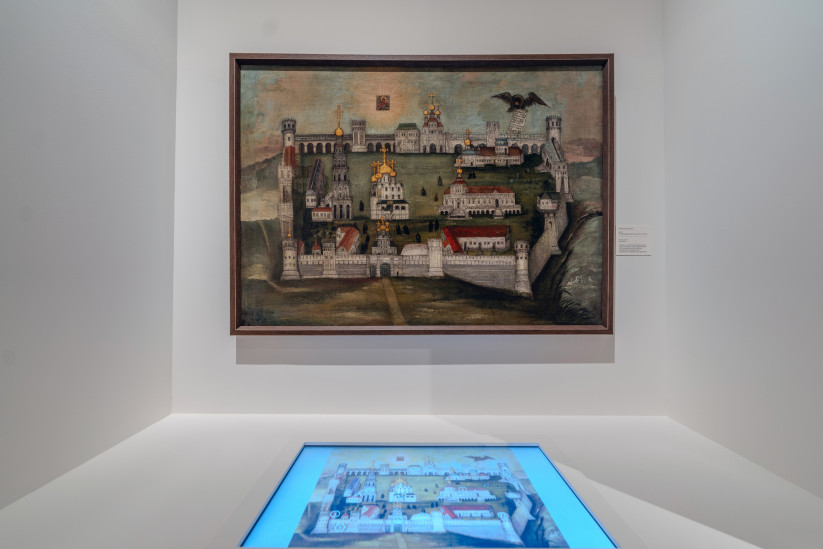
The painting from the 1770s, which depicts the layout of the monastery. Photo: Sergei Militsky
The Royal Abode
The foundation of any historical exhibition is objects preserved from ancient times. Each of them is a storehouse of information, and the curators tried to fill the exhibited artifacts with sound so that it would be easier for visitors to perceive it. Here you could see a dish belonging to the widow of Yuri Vasilyevich, Ivan the Terrible’s younger brother, Princess Ulyana Paletskaya, and a holy chalice placed by the Terrible in the monastery to commemorate the soul of his eldest son Ivan Ivanovich, the same one whom Ilya Repin depicted in the famous painting «Ivan the Terrible and his Son Ivan». An iconostasis with family icons of Tsar Aleksey Mikhailovich and icons created during the reign of Tsarevna Sofia were presented. As the name of the exhibition suggests, visitors moved from one era that affected the life of the monastery to the next.
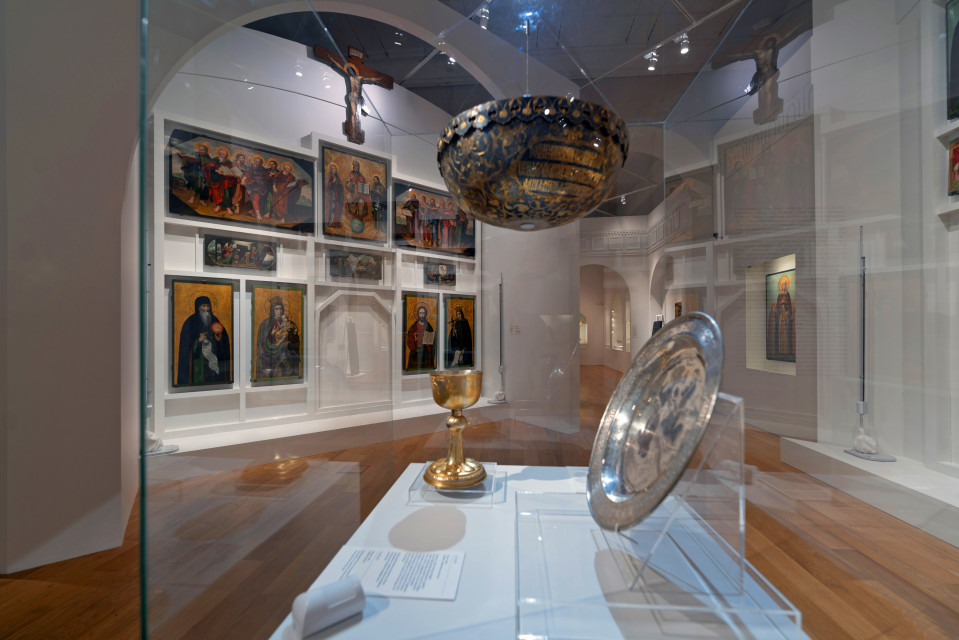
The dish of Princess Ulyana Paletskaya and the holy chalice of Ivan the Terrible. Photo: Sergei Militsky
The basis of any historical exhibition is objects preserved from ancient times. Each of them is a storehouse of information, and the expositors tried to fill the exhibited artifacts with sound so that it would be easier for visitors to perceive it. Here you could see a dish belonging to the widow of Yuri Vasilyevich, Ivan the Terrible’s younger brother, Princess Ulyana Paletskaya, and a holy chalice placed by the Terrible in the monastery to commemorate the soul of his eldest son Ivan Ivanovich, the same one whom Ilya Repin depicted in the famous painting Ivan the Terrible and his Son Ivan. An iconostasis with family icons of Tsar Alexei Mikhailovich and icons created during the reign of Tsarevna Sofia were presented. As the name of the exhibition suggests, visitors moved from one era that affected the life of the monastery to the next.
«This is a votive monastery, that is, it was built according to a vow, ” says Olga Sokolova. "Vasily III promised to build it in case of successful completion of the Smolensk Campaign in 1514. However, it came to the point only 10 years later, when the war with Lithuania was over and Smolensk remained with the Grand Duchy of Moscow. The first monastic buildings appeared in 1524–1525, and in the summer of 1525, a copy of the miraculous icon of Our Lady of Odigitria of Smolensk was transferred to the Novodevichy Monastery in a solemn procession."
It is not known exactly how the icon ended up in Moscow at the beginning of the 15th century — there are various hypotheses on this subject, but none of them have been confirmed. In the middle of the century, the Smolyans turned to the Grand Duke with a request to return to them the image of the defender of the city, who was extremely revered among them. The icon was returned, but first they made a copy of it. And since the embassy was walking along Smolensk Road not far from the place where the monastery later grew, the main cathedral of the monastery was dedicated to Our Lady of Odigitria of Smolensk, where the copy was transferred.
«But the picture of Our Lady, which is on the right side of the door of the sanctuary, is beyond all price, from the quantity of gold and diamonds, rubies, hyacinths, emeralds, and pearls, which are lavished upon it. The same ornaments are abundant on the rest of the pictures, which are on the row of the doors of the sanctuary, and in front of the silver candlesticks, going round the whole of the church as far as the outer doors; and round the pillars are also small pictures, covered with silver and gold, in rows, one above another. Many of them are inestimable, from the weight of pure gold, and precious stones of various colours with which they are inlaid. Even upon the windows and lattices of the church are pictures closing over each other, for want of room. I conjecture that the number of all the pictures must be more than three thousand; so that we were perfectly astonished at the sight of them: for the smallest picture among them is valued at five dinars. We found no likeness, not even among the Emperor’s churches, to the beauties of this church. The Patriarch told our master from his own mouth: 'We possess no convent equal to this in riches; and this is, because all the Nuns who reside in it, and successively resort to it, are Kniayinias, widows, or maiden daughters of the Grandees of the empire, who come with all their property and possessions, their plate, gold, and jewels, which they settle upon the convent. For this reason it is called the Girls' Convent.»
«The travels of Macarius: Patriarch of Antioch» by Paul, of Aleppo, Archdeacon, fl. 1654–1666
The monastery received the status of a royal monastery in the time of Ivan the Terrible, when Ulyana Paletskaya, the widow of the tsar’s younger brother, became one of the nuns. However, there is a suggestion that this could have happened earlier. Perhaps Vasily III thought to place his first wife Solomonia Saburova in the monastery, with whom he lived for 20 years without having children. The Grand Duke needed an heir, so he divorced his wife and remarried Elena Glinskaya, who became the mother of Ivan the Terrible. Solomonia was decidedly not satisfied with this turn of events, she did not want to join a monastery — as a result, she was forcibly tonsured and placed not in the Novodevichy, but in the Pokrovsky Monastery in Suzdal.
«The interior painting and the large new iconostasis of the temple were received during the time of Boris Godunov, ” Olga Sokolova follows the milestones of history. "At that time, the widow of Tsar Fyodor Ioannovich, Boris Godunov’s sister Irina, retired to the Novodevichy Monastery after her husband’s death. Until her brother was elected king, she played the role of head of state, although she became a nun. Boris Godunov followed his sister under the protection of the monastery, and even after he became tsar, he remained there for several more months, only later moving to the Kremlin."
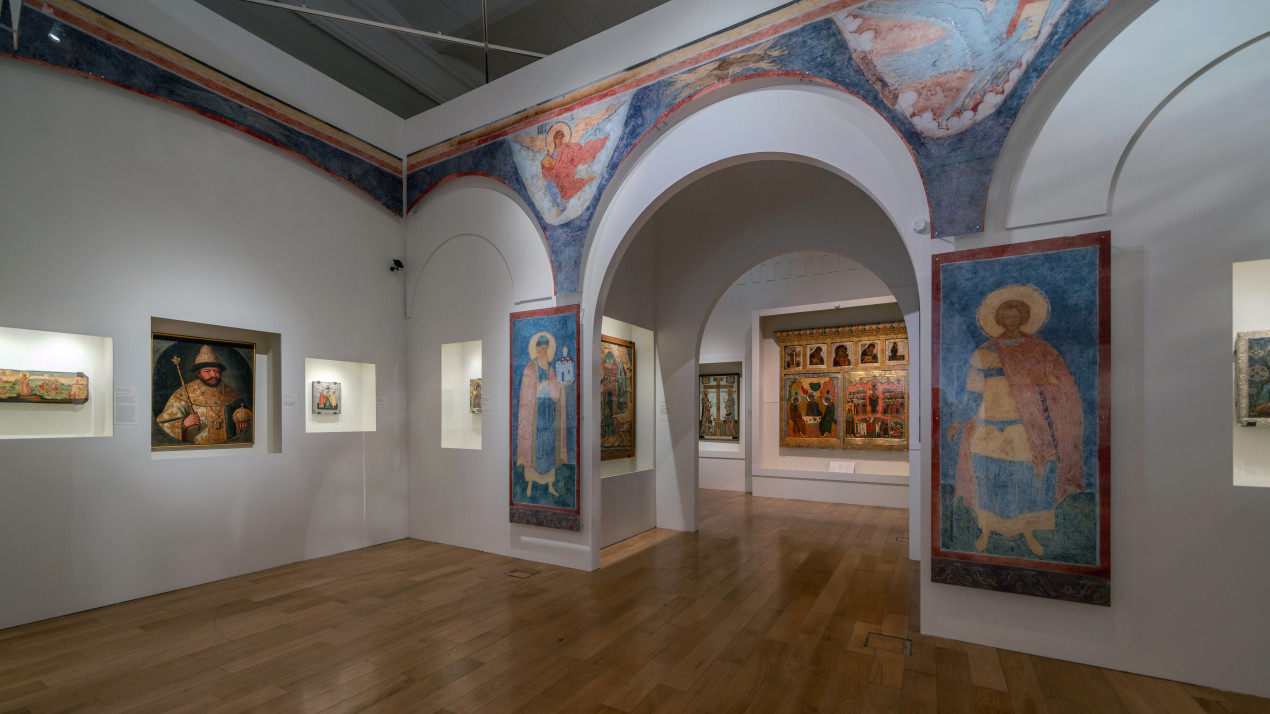
A hall dedicated to the era of Boris Godunov, with murals conveying the spirit of those years. Photo: Sergei Militsky
And in the second half of the 17th century, grandiose construction began in the monastery. It was then that it acquired its current appearance — new walls and towers were erected, and the territory was expanded. All that remained of the old buildings was the Smolensky Cathedral, around which gate churches, stone chambers for the Miloslavsky tsarevnas, and the Assumption Church with a refectory, made in the Moscow Baroque style, grew. All this happened during the regency of Tsarevna Sofia. The fact is that the monastery was one of the favorites of her father, Tsar Aleksei Mikhailovich, who certainly went there on the day of the patronal feast and camped under the walls. It was he who initiated the festivities on the Devichye Pole. The tsar’s children also fell in love with the monastery, and Sofia undertook to decorate it during the regency. She did not yet know that she was doing it for herself — after the deposition, the tsarevna spent the last 15 years of her life in the Novodevichy Monastery.
From the Exhibition to the Museum
The exhibition was a great success and later went to the branch of the Historical Museum in Tula in a slightly modified form — the period of the 20th century had to be abandoned because there was not enough space. Meanwhile, a new museum dedicated to the Novodevichy Monastery is being prepared for opening. A building has already been built for it opposite the monastery.
«Work on its creation began back in 2022, and now we are already at the final stage, preparing multimedia support for the exhibition,» explains Olga Sokolova. «This is done by the same team of authors who designed the exhibition. Having worked out the techniques and ideas in the exhibition version, we can now effectively use them in the museum, understand how to introduce architectural elements into the exhibition, what items to exhibit, and how to organize information support. Of course, the museum has more space, and this gives us additional opportunities.»
For example, it was not possible to present the icon of the era of Ivan the Terrible «The Last Judgment» at the exhibition. Being about 3 m tall, it turned out to be too large and simply did not fit in the exhibition, since it needed a special place. There is no such problem in the museum.
A walk through the exhibition "Novodevichy Monastery: Historical Milestones"
It was not possible to pay due attention to the monastery workshops, which played a major role in the life of the monastery. Already in the early years of its existence, a large gold-sewing workshop appeared in it, which was active until the 18th century. For a while it lost its importance, and in the 19th century it was revived as a «needlework» workshop of a broader focus. There was also a painting workshop at the monastery — for example, the museum’s collection contains numerous examples of the works of the «pictorial women» who studied with her. The local artists who painted the icons had serious training, including academic drawing. It is not surprising that their creations have received international awards.
The turn of the 19th century was also briefly presented at the exhibition. It can be shown in more detail in the museum: the nuns' participation in charity, and their help to the wounded during the First World War, and the closure of the monastery, and its transformation into a museum. A unique exhibit, an album created by students of the Potylikhinskaya School in the 1920s, tells about the last nuns.
«Many experimental schools appeared immediately after the revolution,» explains Olga Sokolova. «The teacher of one of them gathered her schoolgirls and brought them to the Novodevichy Monastery, where they talked with Abbess Vera Pobedimskaya, treasurer Agnes, and elderly nun Leonida Subbotina. In the album, all information is divided into chapters. The text is accompanied by watercolors and sketches.»
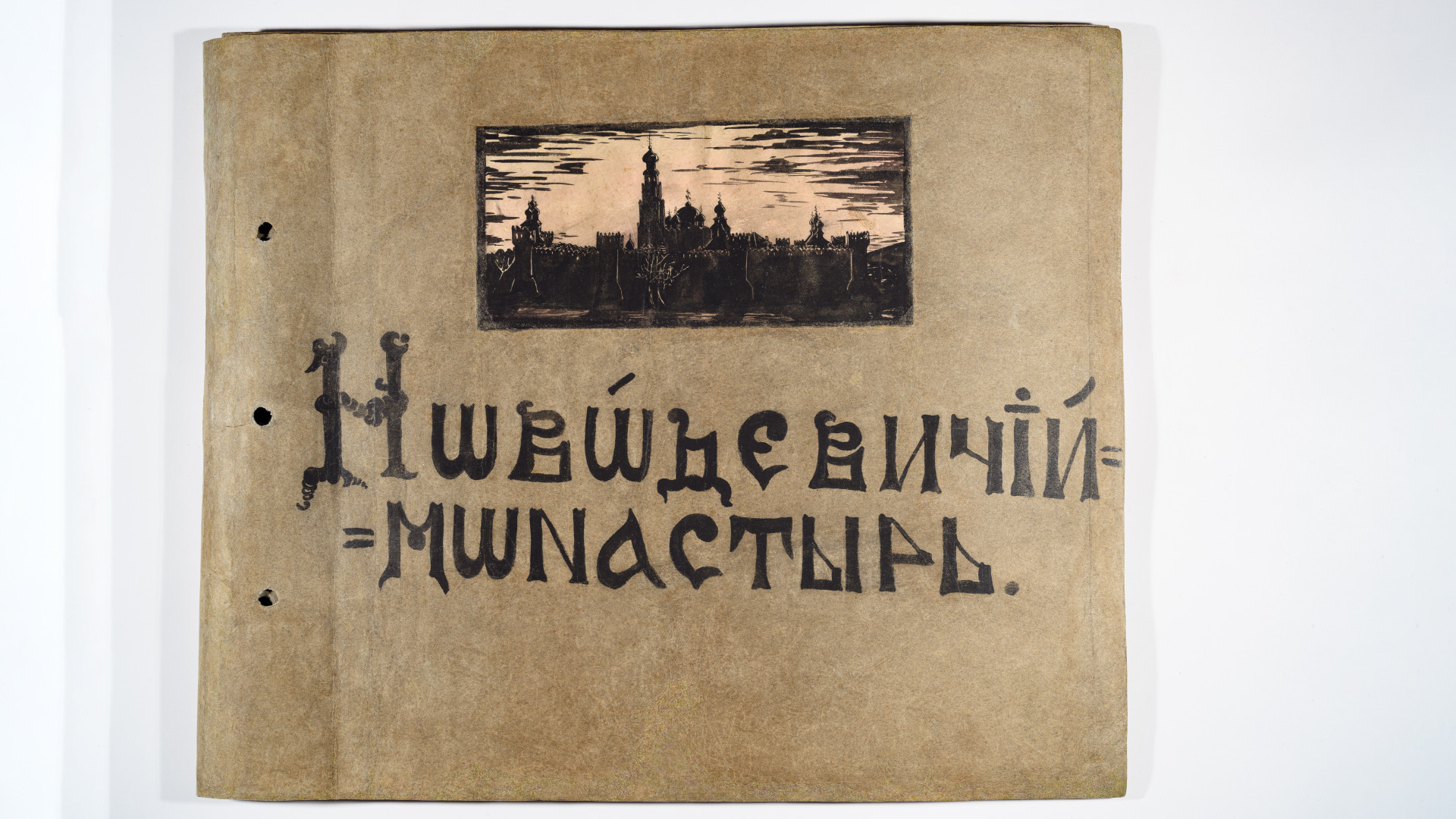
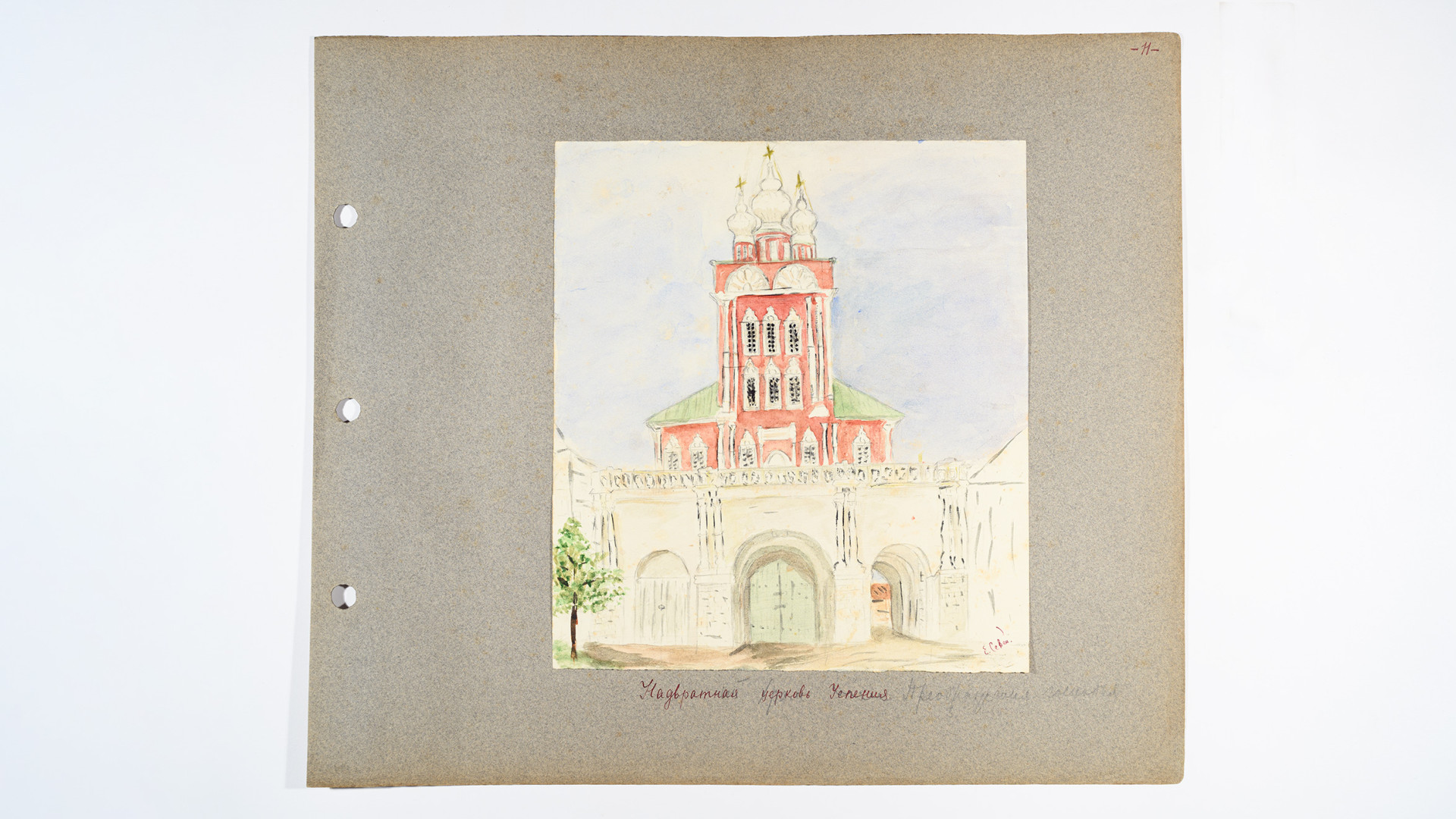
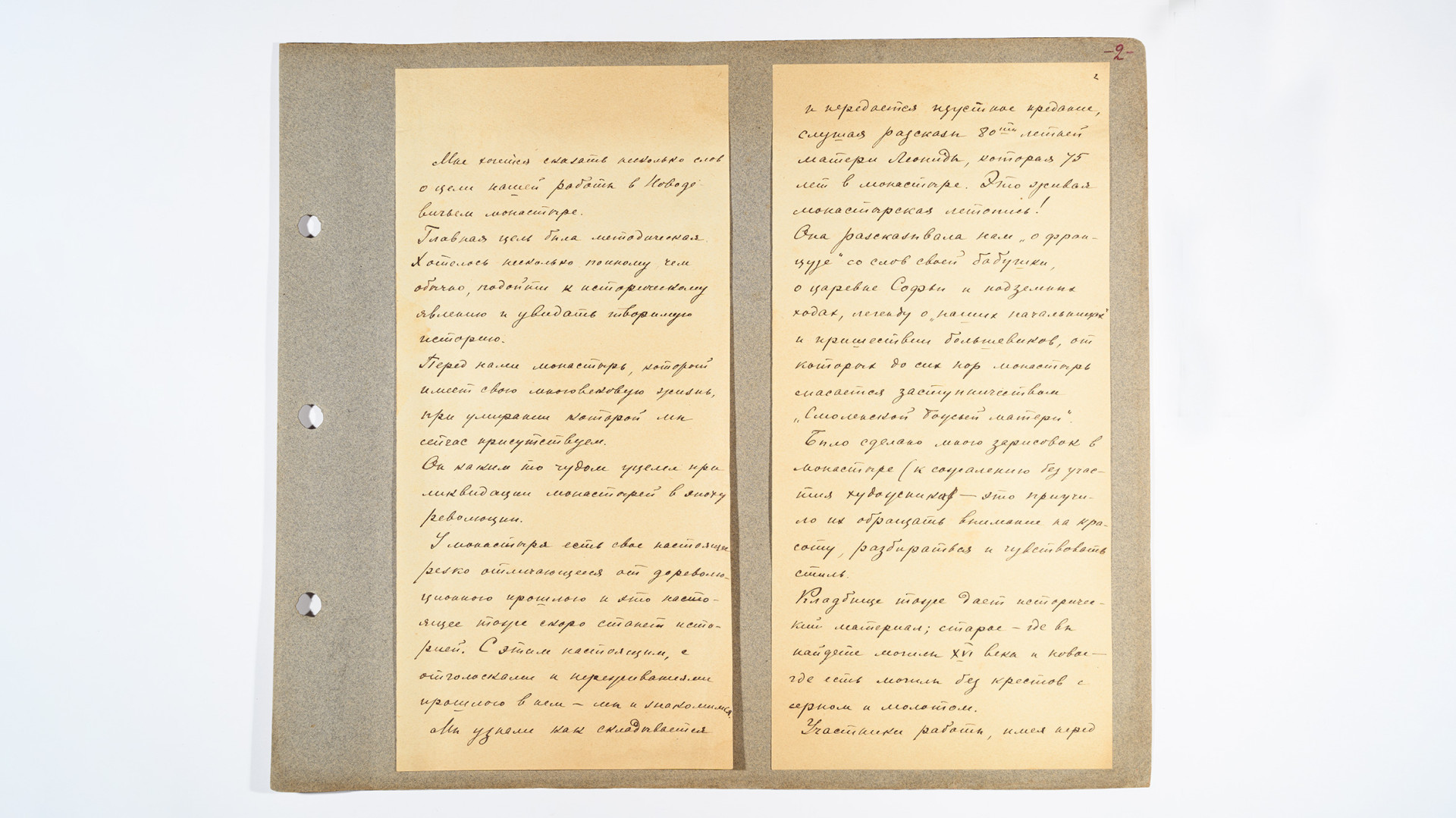
The children’s project, as we would now call this album, reveals the details of a very difficult period in the life of the monastery. The epigraph of the second chapter contains the abbess’s phrase: «There is no monastery — there is a house committee.» She vividly describes the situation in which the nuns found themselves. In the chapter «Mother Leonida» it turns out that the Subbotins had their own ancestral cell in the monastery, which was actually inherited. Treasurer Agnes told about the monastery’s participation in the construction of the infirmary on the territory of the Pokrovsky Monastery and how the nuns worked at the Martynovskaya surgical clinic. Anya Krylova shared her experience of studying at the parish school at the monastery. Considerable attention is also paid to the legends of the Novodevichy Monastery — in particular, that Napoleon lived there, about the visions of the first abbess Elena Devochkina, about how Peter I helped catch church thieves.
The museum will also present in electronic form the so-called book of impressions of the first museum in the walls of the Novodevichy Monastery, where naive children’s notes are juxtaposed with the gratefulness of adults. However, the situation has not changed much since then — the book of reviews dedicated to the exhibition is also full of delighted messages from children’s and adults.
«We are glad to see that the visitors fell in love with our beloved brainchild, ” Olga Sokolova smiles. "When we applied for the RGS Award, we didn’t really hope to receive it — we just tried our best to tell about the project, which we invested both our efforts and our desire to share amazing stories of the past. It was all the more pleasant to know that our efforts were appreciated at such a high level."
Now the exhibition has already stopped its work. But ahead is the opening of the Novodevichy Monastery Museum, which is scheduled for the second half of 2026. It remains to wait for this opportunity to plunge back into the depths of the centuries and walk through the milestones of history.
Olga Ladygina