


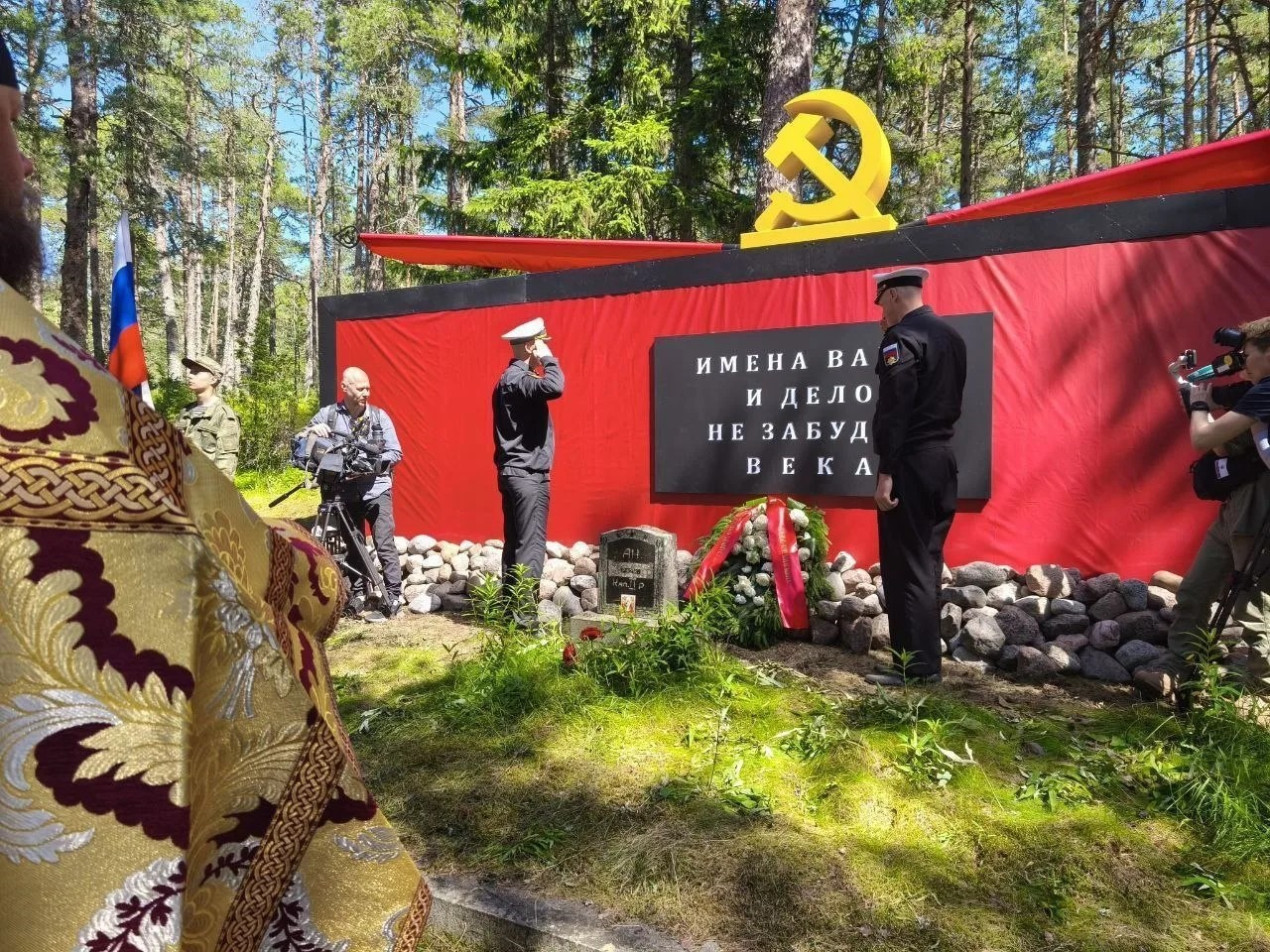
Memorial complex on Gogland. Photo: press service of the Underwater Exploration Team
On the eve of the 85th anniversary of the beginning of the Great Patriotic War, the RGS and the Ludi Morya Foundation, together with the Russian Navy, held a memorial campaign «Remember the War: The Baltic Sea». The expedition members installed an Orthodox belfry and restored a memorial complex at the burial site of fallen Soviet soldiers on the island of Gogland in the Gulf of Finland.
«We are not only paying tribute and showing gratitude to the heroes who defended the maritime borders of the Fatherland,» said Artyom Melnikov, President of the Ludi Morya Foundation. «This project is an important step in preserving historical truth for future generations. Gogland is a special place of power and memory. The installation of the belfry and the restoration of the memorial are our conscious contribution to ensuring that no feat or name is forgotten.»
The «Gogland» project has been implemented by the RGS since 2013. Scientists and search specialists explore the islands and waters of the Gulf of Finland to form a complete and reliable picture of the history and nature of the region. During the expedition in 2026, an Orthodox belfry with an icon of St. Andrew the First-Called and a fragment of his relics was installed on the island of Gogland. The bells for it were donated by the Danilov Monastery in Moscow, where they were cast in workshops. An obelisk was restored next to the belfry at the memorial complex, which was destroyed during the occupation by Finnish troops. There is a mass grave of soldiers who died in 1942 during the heroic defense by Soviet soldiers, which lasted almost two months.
«We came here, as they say, in peace: for too long this place has served as a reason for the confrontation of countries and peoples, too little attention has been paid to its content,» said Ekaterina Khutorskaya, coordinator of the «Gogland» expedition. «Gogland and its surroundings can and should become a platform for cooperation, mutual respect and prosperity for all. Therefore, there is only truth and facts, only for the benefit of its unique nature.»
The geographical location of the island of Gogland in the Gulf of Finland has turned it into a key point for controlling the sea routes and made it the scene of important historical events. In the 18th century, Gogland became one of the most important conquests of the Russian Empire, which regained the lands previously occupied by the Swedes. A century later, Gogland attracted scientists and became the site of the first ever practical wireless communication session. The radio station installed here not only helped to save the battleship «General Admiral Apraksin» but also transmitted a signal about fishermen on a detached ice floe, which led to their rescue by an icebreaker and marked the beginning of the mandatory equipping of ships with radio stations. In the 20th century, the island once again found itself in the epicenter of military operations: in 1940, it entered the defense sector of the Kronstadt base. In August 1941, it sheltered thousands of participants in the Baltic Fleet’s transition from Tallinn to Kronstadt; and in 1942, Soviet paratroopers heroically held the line here for almost two months.
«The RGS has been conducting a memorial vigil on Gogland, the largest outer island of the Gulf of Finland, since 2013,» said Natalya Belyakova, Director of the Expeditionary Activities and Research Department of the RGS. «Since the first days, the expedition has been supported by the Main Command of the Navy, the Russian Baltic Fleet, and the Leningrad Naval Base. Thanks to the Society’s work with the Ludi Morya Foundation, exploratory and historical-memorial research has gained a new dimension. The restoration of memorials has been complemented by the creation of digital replicas of memorable objects, thanks to which you can get acquainted with the history of Gogland from anywhere in the world. One of them is the belfry on Gogland, which became the third in the Baltic. It complemented the route, which includes an updated memorial to those who died in 1942 and a revived 1939–1940 amphibious burial site discovered by our expedition in 2014. The memory watch is not tied to dates — it is the duty and the foundation for the upbringing of patriots.»
The events of the RGS on Gogland continue large-scale work on the creation of memorial objects at key points in the maritime history of Russia. In 2025, the belfry was opened on Sommers Island, and in 2026, in Kronstadt.
Специальный репортаж: Евгения Пастыка, Фонд «Люди моря»