

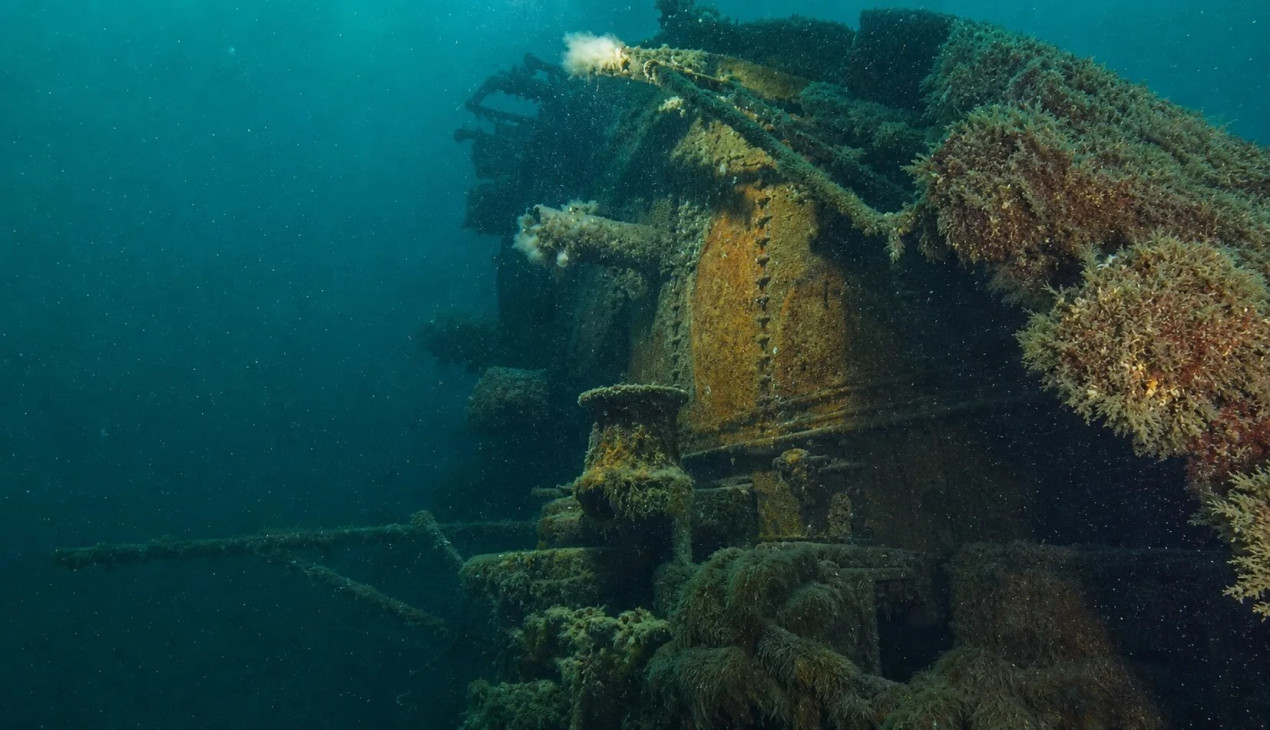
The bow section of the ship “Utlandshörn”. Photo: Konstantin Bogdanov’s Underwater Exploration Team; the image of the object was processed using ChatGPT
During the expedition of the RGS «Voices of the Lost Ships», Konstantin Bogdanov’s Underwater Exploration Team discovered and identified the German transport vessel «Utlandshörn». It was blown up by mines set up by Soviet torpedo boats at the exit from Pechenga Bay near the village of Liinakhamari.
The «Utlandshörn» was built in Hamburg in 1927. The vessel was 105 meters long, with a gross tonnage of 2,643 register tons, and its full displacement reached approximately 4,400 tons. Initially, the ship was named «Cartagena»; later it was renamed «Golfo de Panamá», and in 1939 it received its final name. At the beginning of World War II, the German navy leased the ship to transport cargo, and after the attack on the USSR, it supplied German troops, plying between Kirkenes and Liinakhamari.
«The object was found at a depth of about 50 meters using side-scan sonar, ” said Konstantin Bogdanov, head of the "Voices of the Lost Ships" expedition. "When we descended to the bottom, we discovered that the bow was lying on its side, while the rest of the hull was turned upside down and practically collapsed. It’s hard to say whether the ship capsized immediately after the explosion or whether the hull collapsed over time. Currently, a 20-meter fragment of the bow and the stern with the propeller are available for inspection."
On its last voyage, the «Utlandshörn» set out early in the morning of March 16, 1942. The ship, unladen (in ballast), accompanied by two patrol ships, was heading from Liinakhamari to Kirkenes. As it left the Pechenga Bay, it struck a Soviet heavy naval mine that had been laid earlier by patrol boats, small hunters MO-153 and MO-163. After the explosion, the transport quickly sank; 19 sailors and military passengers died, and another 36 people were rescued by German ships. This was the first victory of Soviet motor boats’ mine weapons in this sector.
The vessel was accurately identified thanks to the fact that explorers found the ship’s bell, on which the inscription with the transport’s original name, the «Cartagena», was well preserved. The search operations are being carried out with the support of the Presidential Grants Fund and DOSAAF of Russia. The team’s immediate plans include a detailed analysis of the filmed underwater materials and working with archives to create a documentary film.