
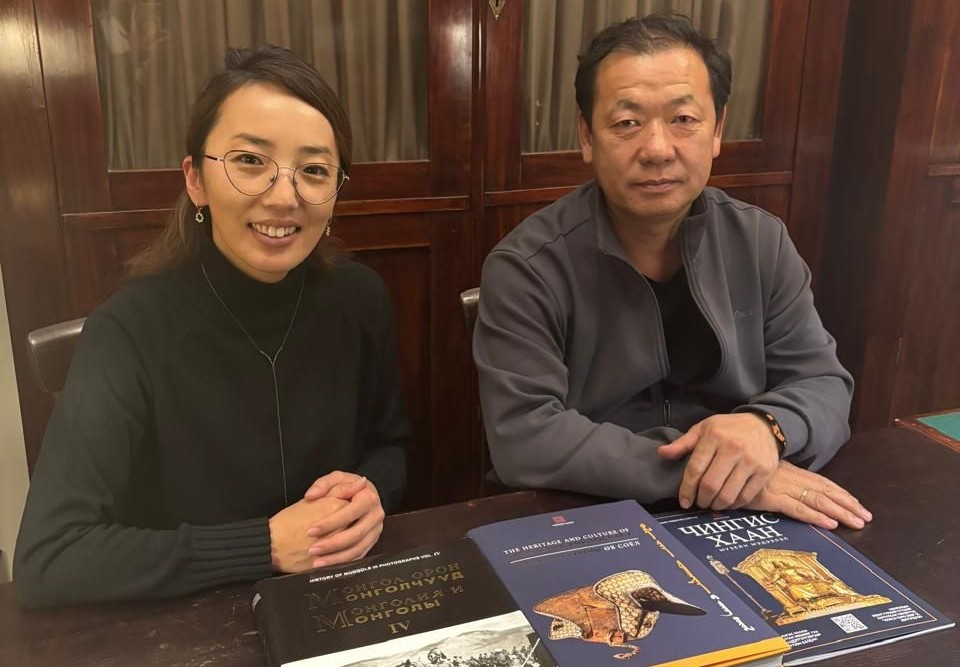
A delegation of Mongolian scientists visited the Scientific Archive of the Russian Geographical Society in St. Petersburg. Historians and archaeologists from the neighboring country collect information about Mongolia’s past, in the study of which Russian scientists played a major role. Many of the materials of those studies are carefully preserved in the Scientific Archive of the RGS.
Director of the Institute of History and Ethnology of the Mongolian Academy of Sciences, Candidate of Historical Sciences, Professor at the Mongolian State University of Science and Technology Lkhagvasuren Erdenebold works in the field of history and archeology, as well as ethnography, ethnology, and anthropology. The scientist has published a number of articles on the excavations of the Zuun Salaa Xiongnu burial ground, the culture of the early Xiongnu, and the traditional religious beliefs of the Oirat Mongols in the period from the end of the 19th to the first half of the 20th century. This is not the first time Professor Erdenebold has visited the Scientific Archive of the RGS. This time, he was interested in the personal collections of famous Russian explorers: Peter Kozlov and Grigory Grumm-Grzhimailo, as well as travel notes of Siberian merchants who travelled through the territory of modern Mongolia.
«These records were made at different times and describe, in particular, very famous archaeological sites of the Turkic period, which are still there, » said the scientist. «We have no information about their discovery and research in Mongolia, but the RGS collections contain unique documents collected during Russian exploration, and I have the happy opportunity to get acquainted with their contents.»
Agvaantseren Mandirmaa is a representative of the Chinggis Khaan National Museum, which opened in the capital of Mongolia, Ulaanbaatar, in 2022. The museum is actively engaged in scientific, educational, and publishing work.
«The director of our museum, Academician Sampildondov Chuluun, plans to publish a series of albums 'Mongolia and the Mongols in Photographs’», said Agvaantseren Mandirmaa. «Of course, we could not ignore the Scientific Archive of the RGS, since Russian explorers and merchants actively traveled around Mongolia, and here, in the collections of the RGS, the richest photo archives have been preserved.»
Cooperation between our countries in the field of geography has a long history. It is known that among the honorary members of the Imperial RGS there were several representatives of Mongolia. Now scientists from a neighboring country are collecting information about their history and their ancestors literally all over the world. Ten volumes of the large-scale project «Heritage and Culture of the Nomadic Aristocracy» have already been published. Specialists from the RGS and the Institute of Oriental Manuscripts of the Russian Academy of Sciences, as well as their colleagues from the Geographical Society of London, the Danish Museum of Ethnology, and other scientific organizations around the world have worked on it.