
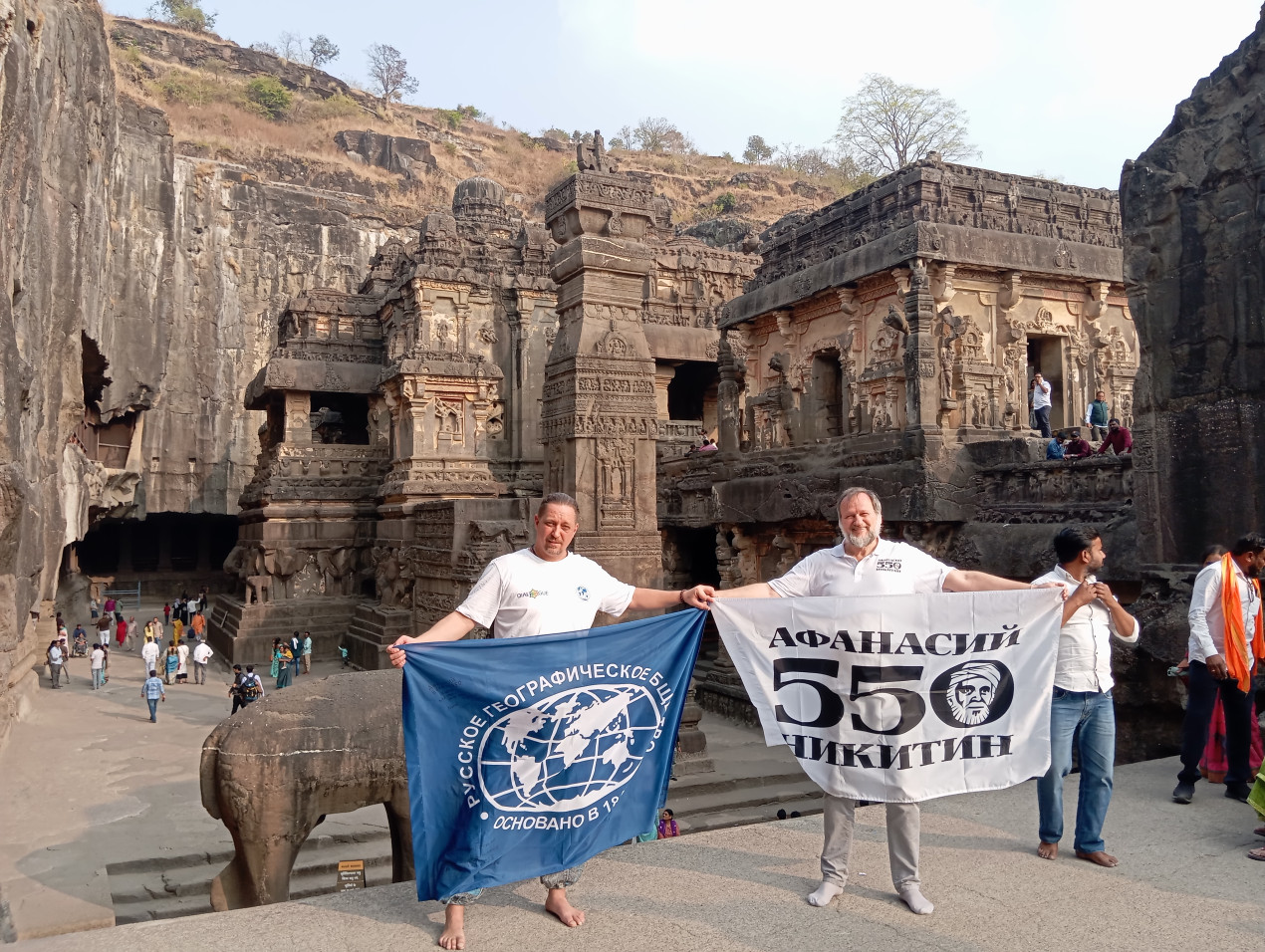
Ellora, India, 8th century. Photo courtesy of Ilya Bannikov
During the international project «In Search of Afanasy Nikitin’s Indian Jerusalem,» researchers tested four hypotheses about the localization of the ancient religious center of Parvat (Pervot), which was described by a Tver traveler and merchant in the monument of ancient Russian literature «Voyage Beyond Three Seas».
During the 2025 field stage, scientists traveled part of the Indian route of Tver merchant Afanasy Nikitin, who found himself in these lands on a research mission in the late 1460s and early 1470s. The main purpose of the 2026 expedition is to collect and analyze information by examining religious centers that claim to be Parvat. Afanasy Nikitin considered it the central place of Indian pilgrimage, comparable in importance to Jerusalem for Christians and Mecca for Muslims.
«The route and timing of the initial stage of Afanasy Nikitin’s journey are well known to scientists. Until March 1470, he was in the capital of the Bidar sultanate, then, together with a group of Hindu pilgrims, he went to Parvat. The Tver merchant was on the road for about a month,» said Aleksandr Bobrov, the project’s scientific director and a leading researcher at the Institute of Russian Literature (Pushkin House). «The further course of his movements is much more difficult to trace. This is probably due either to the loss of some of the records, or to a pause in record keeping. Localization of Parvat is important not only for clarifying the route and chronology of the trip, but also for a deeper understanding of Afanasy Nikitin’s goals and intentions.»
This year, the scientific team traveled from Mumbai to Gokarna, visiting four religious centers in India. At the current stage of the exploration, two Hindu pilgrimage centers, Srisailam and Gokarna, are recognized as the most promising candidates for the role of Parvat. This is due to the geography of the route, the length of Afanasy Nikitin’s journey, as well as the religious and cultural features that the researcher described in his book.
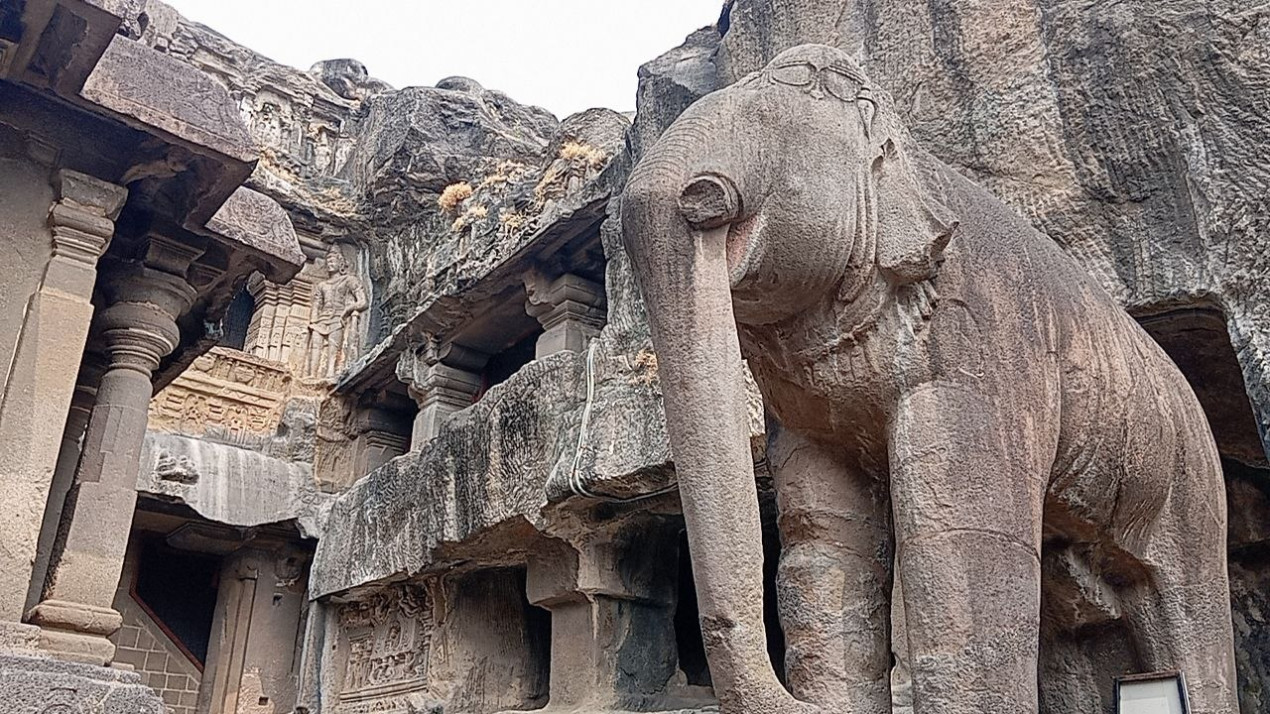
Kailasa Temple (cave No. 16), Ellora, India, 8th century. Photo courtesy of Ilya Bannikov
«During the second Indian stage of the expedition, we conducted research in the field, consistently comparing the text of 'Voyage Beyond Three Seas’ with the modern visual appearance of ancient religious centers in India, » said Ilya Bannikov, head of the expedition, representative of the Krasnoyarsk Regional Branch of the RGS. «We analyzed architecture, iconography, ritual practices, pilgrimage density, and correlated distances and route logic with Afanasy Nikitin’s description of Parvat. In many cases, the discrepancy between what was expected in the text and what was actually observed on the spot became the most revealing.»
The main result of the field trip will be a detailed comparative analysis of all hypotheses of the localization of the toponym Parvat, highlighting their strengths and weaknesses. The scientists plan to include the results in an article for the scientific collection «Afanasy Nikitin and His Epoch», as well as use them in preparing comments to the text «Voyage beyond Three Seas» in the new (fourth) academic edition of the work of Afanasy Nikitin.
«Today we continue to develop business and cultural ties with the BRICS countries, and Afanasy Nikitin’s personality is once again becoming a symbol of Russian—Indian friendship,» says Natalya Belyakova, PhD in History, Director of the Expeditionary and Research Department of the RGS. «Therefore, it is important for us to continue our expedition research, as well as analyze historical literature that will help us trace the development and formation of political and economic relations between the two countries through the activities of outstanding travelers.
The international expedition project «In Search of Afanasy Nikitin’s Jerusalem» is being implemented together with the academic project «Afanasy Nikitin — 550» and with the support of the Russian Geographical Society, Krasnoyarsk Regional Branch of the RGS, Institute of Russian Literature (Pushkin House) of the Russian Academy of Sciences, in partnership with Russian Houses in New Delhi and Mumbai, the Centre for Eurasian Studies of Mumbai University, and the international expedition project «In Search of Afanasy Nikitin’s Indian Jerusalem», ANO for the development of humanitarian cooperation «Dialog».