
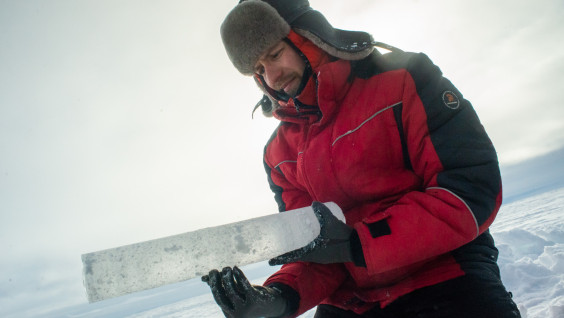

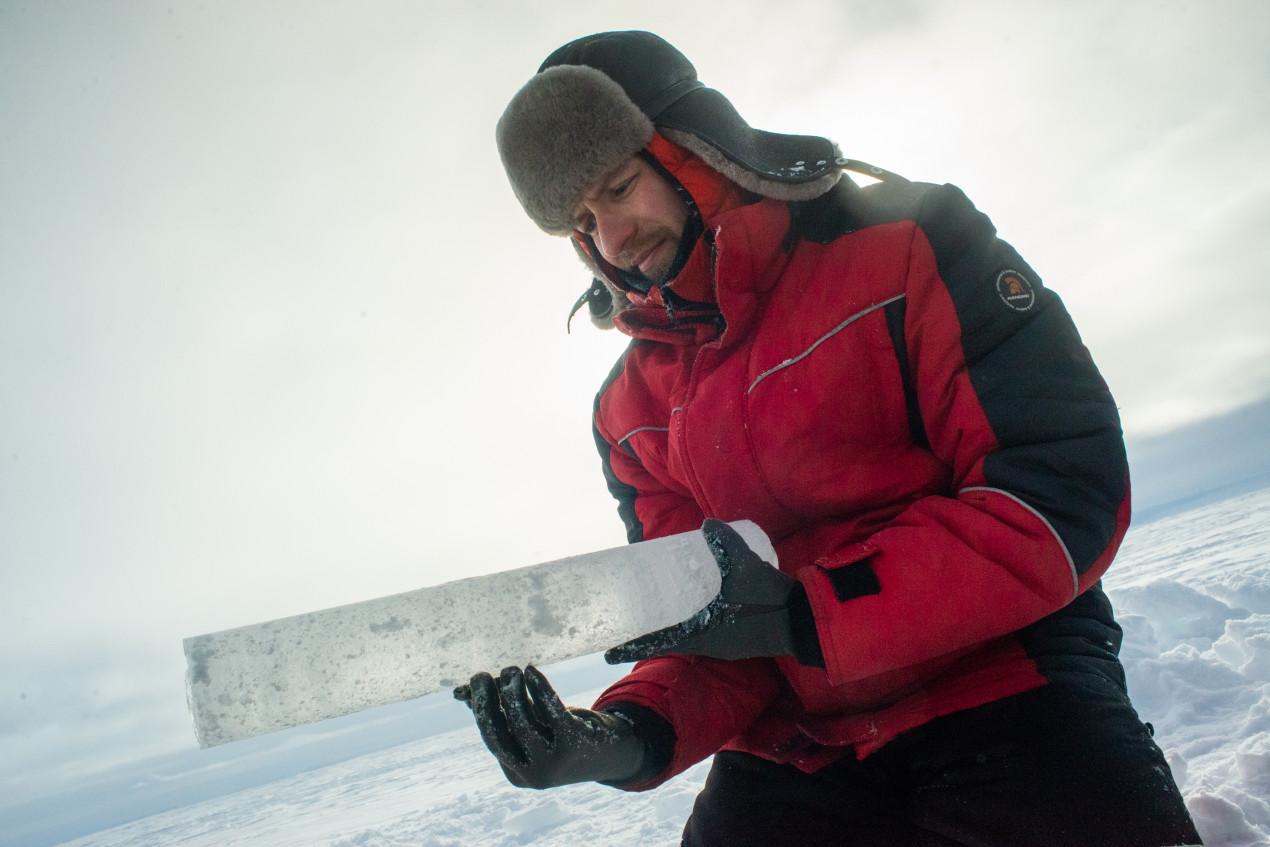
During the 2025 expedition, glaciologists drilled glaciers for core sampling. Photo: Vadim Shtrik / GeoPhoto
The RGS and the Russian Ministry of Defense have started the first in 2026 field season of the expedition on the island of Alexandra Land. In the next two weeks, Russian Arctic National Park will become a laboratory for scientists who will work in seven areas: from drilling glacial domes to monitoring the ionosphere and mapping underwater ecosystems using drones. The main task is to understand how the high-latitude Arctic is changing.
Current climate models show that the Arctic is warming two to four times faster than the average of other regions on the planet. Measurements confirm that temperatures in the region have increased by 3°C over the past 50 years (2023 analysis by the team of climate change experts from the IPCC). The accelerated melting of glaciers, including those on Franz Josef Land, is changing the balance of Arctic ecosystems and the landscape.
«Franz Josef Land is a natural testing ground where the effects of climate change are particularly pronounced, ” said Aleksandr Dobryansky, scientific director of the expedition, an employee at the Institute of Geography of the Russian Academy of Sciences. "Long-term studies of the archipelago allow us to understand how the Arctic as a whole is transforming: from the rate of ice melting and migration of biological species to the carbon balance in soils."
During this season, glaciologists plan to extract ice cores from a 20-meter depth for further research. These are special ice samples that are obtained by drilling. Such material is important for building climate models of the future Arctic region. In addition, scientists will continue to monitor and expand the network of ablation stakes. In previous years, a system of poles driven into the glacier was installed by specialists on the Lunny and Kropotkin domes. Researchers need the network to measure the rate of melting of ice and snow.
On the Arctic island, scientists will test a heliogeophysical complex for monitoring space weather in the Arctic. With the help of such equipment, it is possible to quickly measure the characteristics of the Earth’s magnetic field. This is important for the operation of communications, navigation and radar facilities in the Northern Sea Route area. The data obtained can help to adjust the routes of Arctic shipping. A separate block of work will be devoted to the study of the carbon cycle in the freshwater lakes of Alexandra Land Island. The information obtained during the work will help, for the first time in this region, to assess the intensity of biogeochemical processes that occur in isolated subglacial reservoirs, as well as to understand how climate change affects greenhouse gas emissions from lake ecosystems at high latitudes.
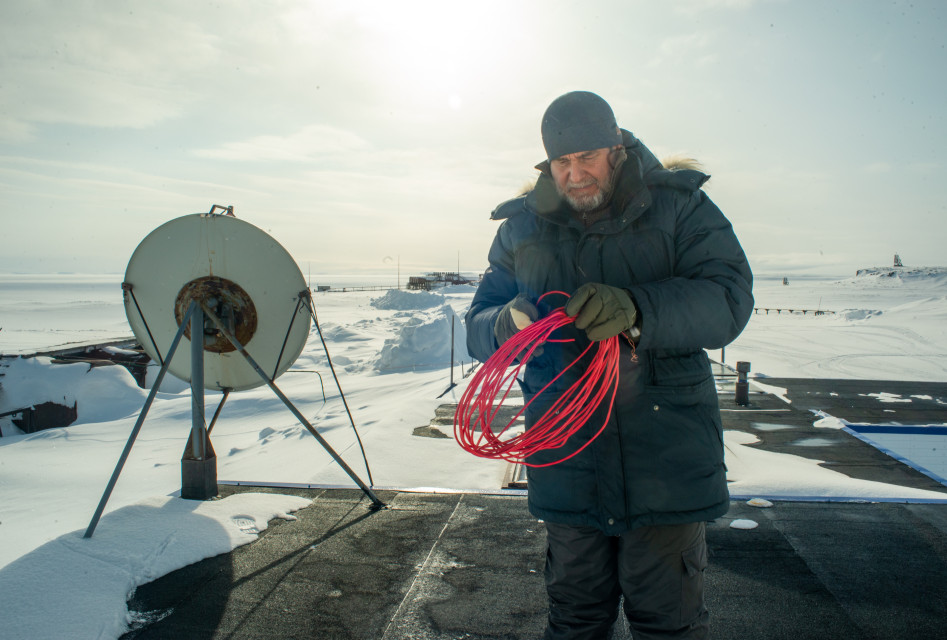
Albert Yanakov, a scientist at the IKI RAS, during the installation of space weather monitoring equipment. Photo: Vadim Shtrik / GeoPhoto
Traditionally, for the spring season, biologists will monitor polar bears, Atlantic walruses, and other marine inhabitants of Alexandra Land. Specialists use drones to work underwater. Video recordings combined with measurements of water composition and plankton sampling using a special Juday net (designed to collect tiny organisms) allow to provide complete information about the species composition and spatial distribution of aquatic organisms, such as microscopic crustaceans.
«Scientific activity on Franz Josef Land has a pronounced continuity and seasonality. Research teams work annually in April and August,» said Natalya Belyakova, Director of the Expeditionary Activities and Research Department. «This spring we are studying the formation of icebergs and the impact of space weather on navigation systems. Since the end of summer, there is a window for exploring objects in the ice-free territory of the archipelago. We continue to equip our scientific laboratory. In addition to the microscopes, a centrifuge, snow measuring stakes, moisture meters, a freezer, a drying cabinet, and other equipment available there — now scientists do not have to take this equipment with them every time — we will deliver an innovative domestic system for automatic monitoring of soil temperatures and snow cover.»
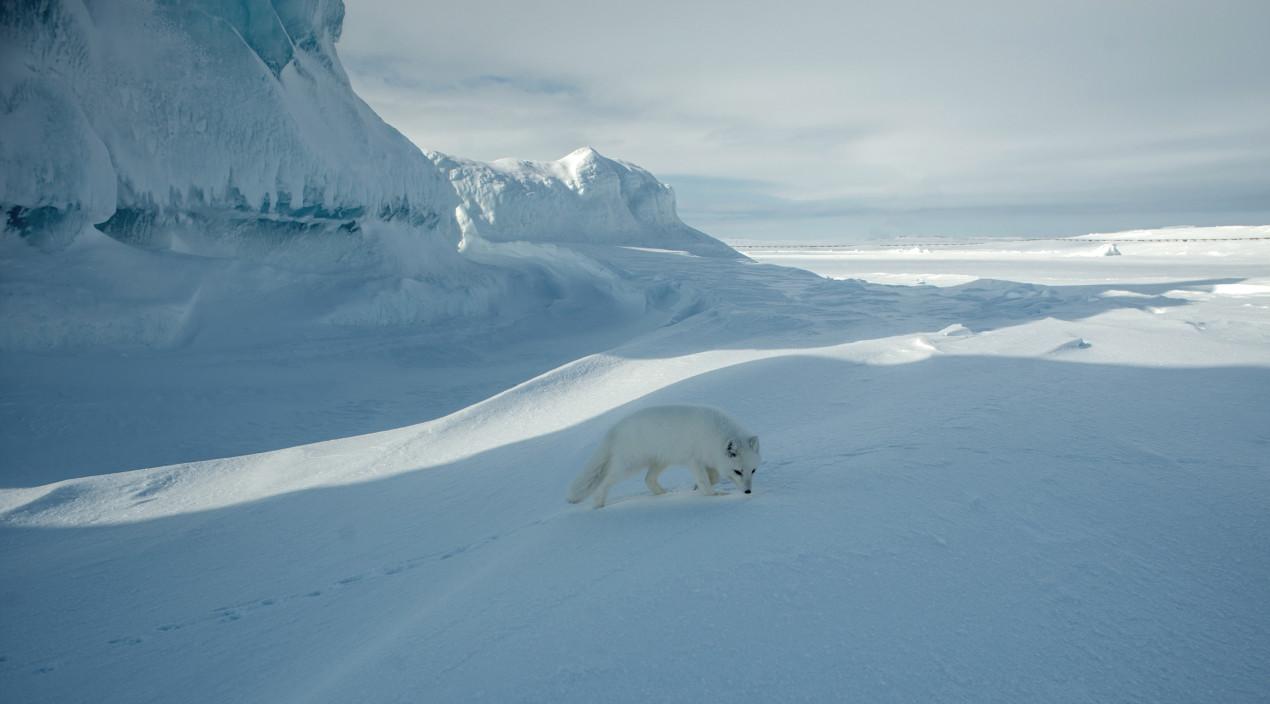
A local resident. Photo: Vadim Shtrik / GeoPhoto
Scientists from the Institute of Geography of the Russian Academy of Sciences, the Space Research Institute of the Russian Academy of Sciences, the Russian Federal Research Institute of Fisheries and Oceanography, and the Peoples' Friendship University of Russia will take part in the expedition.