
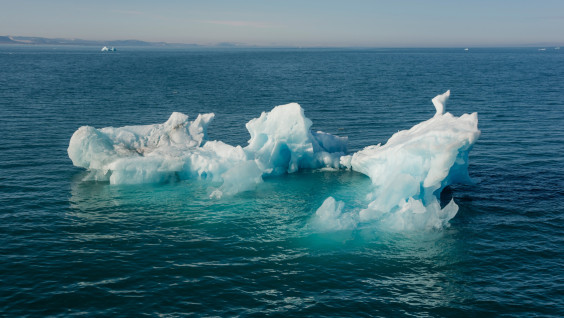

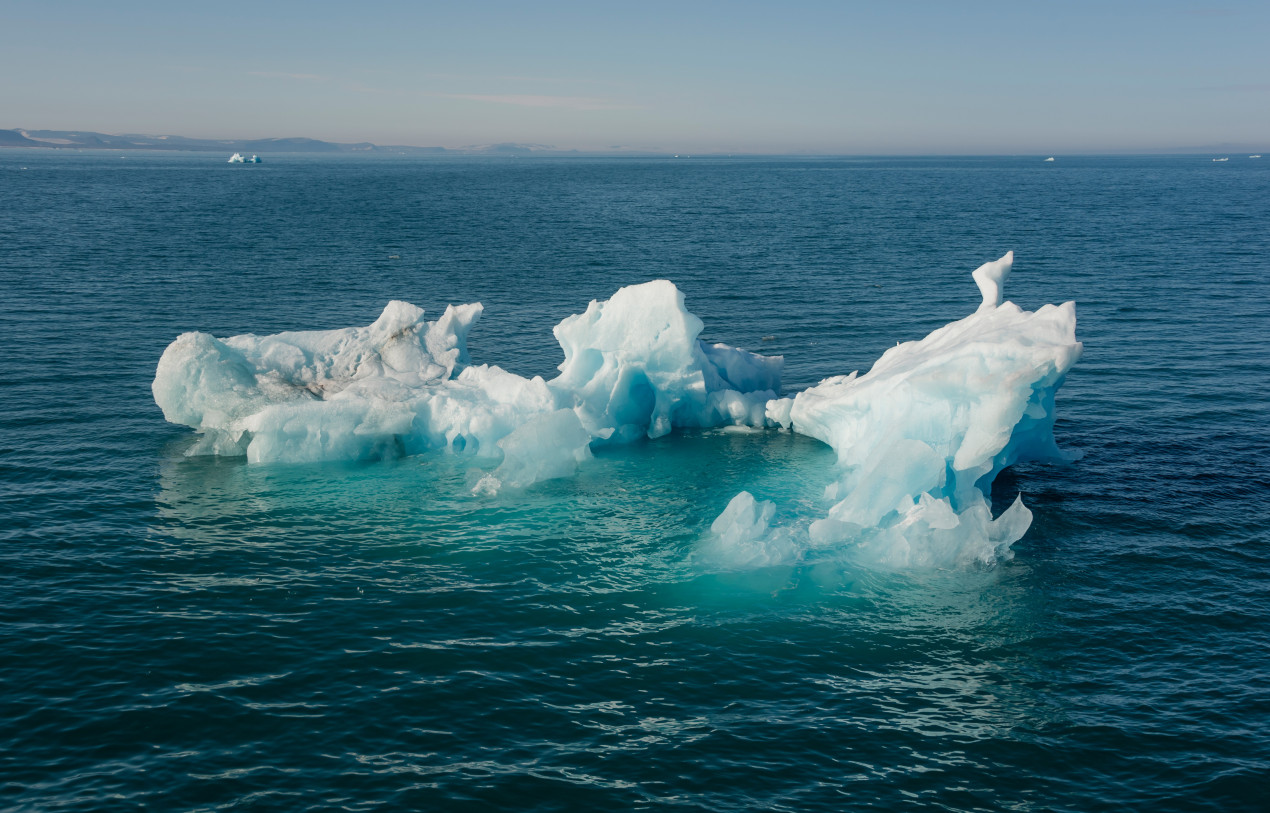
There is less ice in the Arctic every year. Photo: Leonid Kruglov
Russian scientists have identified a new reason for the rapid melting of multi-year ice in the Greenland Sea, which allows to make a forecast of this phenomenon several years before it begins. This, among other things, will make it possible to choose routes and navigation dates along the Northern Sea Route in advance and more accurately.
It is well known that the Arctic is the most sensitive indicator of climate change on the planet. There are a number of reasons for this. One of them, oceanological, was indicated by researchers from the Arctic and Antarctic Research Institute (AARI). Their proposed mechanism for predicting abnormal ice melting in the Greenland Sea is based on measuring the heat content of Atlantic waters entering the Arctic Ocean through the Fram Strait.
The results of observations over 27 years demonstrate that the key factor in ice degradation is the warming of Atlantic waters. The main role here is played by advection, that is, the horizontal transfer of heat through the Fram Strait. Scientists have identified two dominant mechanisms. The first is direct and short-term: warm waters flow to the lower boundary of the ice and cause it to melt within one to six months. The second one is long-lasting but more significant: the increased summer-autumn intake of Atlantic waters through the Fram Strait increases the thermal content of the subsurface layer. Through vertical heat exchange, which intensified in the mid-2010s, this heat causes accelerated melting of multi-year ice after two to three years. It is this effect that opens up opportunities for a medium-term forecast.
«Atlantic waters are penetrating deeper into the Arctic, violating the usual stratification, that is, the division into layers. As a result, the heat reaches the ice at the surface,» said Natalya Lis, a researcher at the AARI Oceanology Department. «In this case, the ocean plays the role of a thermal accumulator — it accumulates thermal anomalies, which then reach the ice sheet.»
The study is based on the analysis of observational data and ERA5, ORAS5, and CMEMS climate reanalysis for the period of 1996–2023. The work was supported by the Russian Science Foundation (grant No. 24–27-00221).