
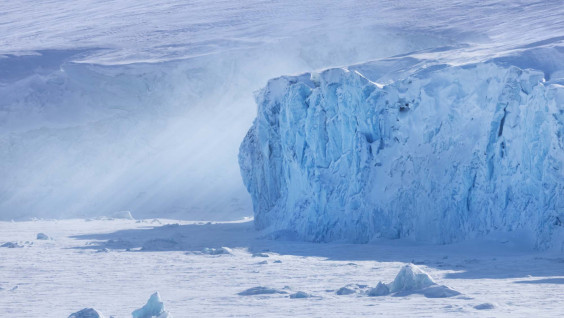

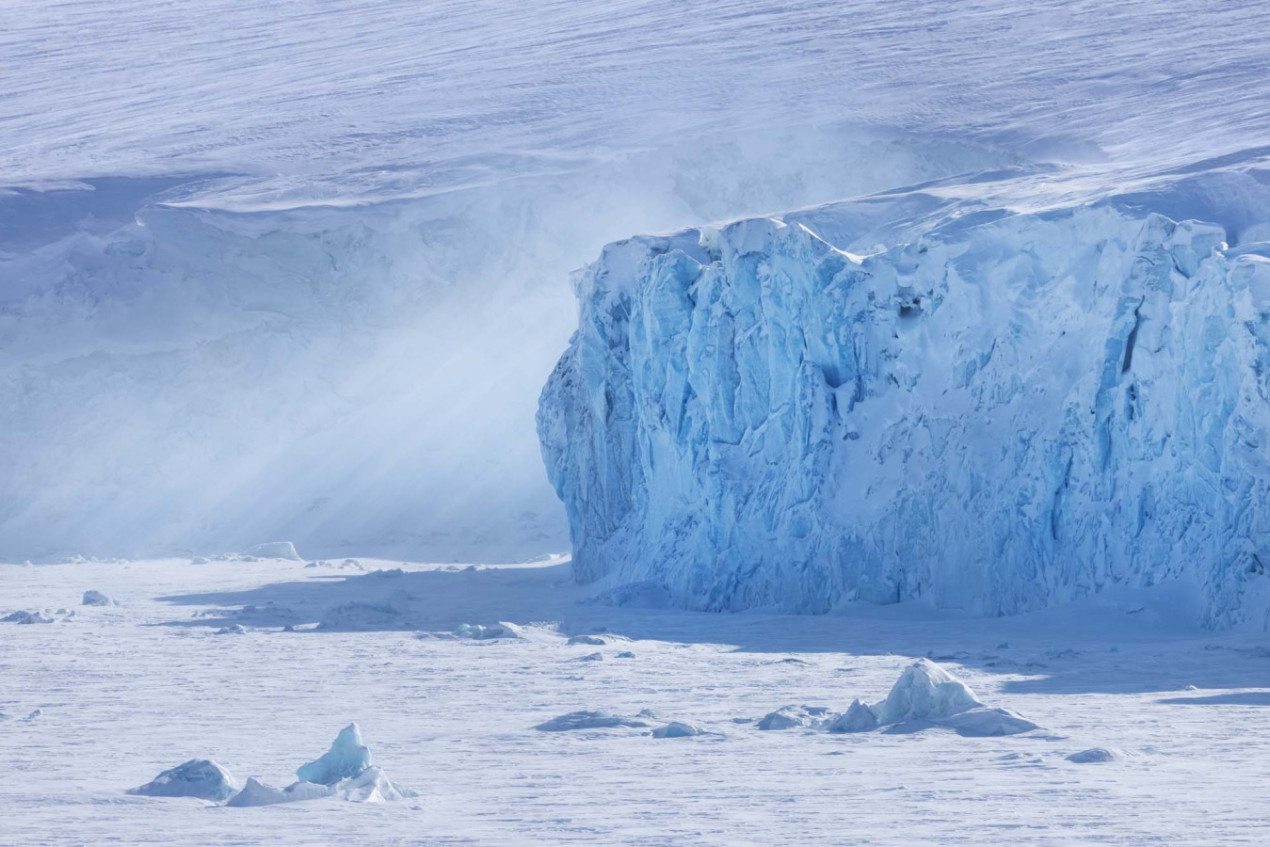
The new method will make it possible to more accurately assess the impact of climate on glaciers. Photo: Nikita Mikhalchenko, a participant in the RGS’s competition “The Most Beautiful Country”
Specialists from the Arctic and Antarctic Research Institute (AARI) have identified an additional non-climatic signal in the data on glacier shrinkage, which may affect the accuracy of climate assessments. The conclusions are based on many years of study of the Aldegonda and West Grenfjord Glaciers on the Spitsbergen archipelago.
The mass balance of glaciers is considered one of the most important indicators of climate conditions. Such data are especially significant for remote areas of the Arctic, where regular meteorological observations are limited or non-existent. Scientists have established that when making calculations, it is necessary to take into account not only air temperature and precipitation, but also changes in the spatial configuration of a glacier.
Observations of the Aldegonda and West Grenfjord Glaciers in the area around the settlement of Barentsburg have been carried out since 2002. This is one of the longest and most detailed series of measurements in this part of the Arctic. Between 2015 and 2025, the glaciers lost more than 20 and about 18 meters of water equivalent mass, respectively.
«A glacier is a living, constantly changing object. As it melts, its surface gets lower and lower, and down there, the air is warmer — and as a result, the ice begins to melt even faster, even if the weather outside hasn’t changed by so much as a degree. Right now, this effect is small, but if we don’t take it into account when analyzing longer series of observations, we risk mistaking part of the glacier’s own 'geometric’ history for a climate signal that doesn’t actually exist», explained Anton Terekhov, a senior researcher at the Arctic and Antarctic Research Institute.
The mass balance was calculated by specialists using two methods: taking into account annual changes in the surface and relative to the geometry recorded in 2008. A comparison of the results showed that the shift to lower and warmer altitude zones increases ice loss on Aldegonda by 1–2% annually, and on West Grenfjord by 0.5–1%. This share is not directly related to climate change.
Over the past two decades, the additional effect has remained small and has not yet distorted the overall climatic assessment. However, as observations continue and mass loss accelerates, its impact will become more noticeable. Researchers emphasize that in recent years, the rate of glacier shrinkage on Spitsbergen has reached an unprecedented level.
The proposed approach can also be used in other regions of the world. The satellite digital elevation models ArcticDEM and REMA cover the entire Arctic and Antarctic and allow for similar calculations for virtually any glaciation center. This will help to more accurately distinguish the effects of global warming from changes caused by the restructuring of the glaciers themselves and to improve forecasts of their future state.
The research results are published in the journal «Arctic and Antarctic Research».