
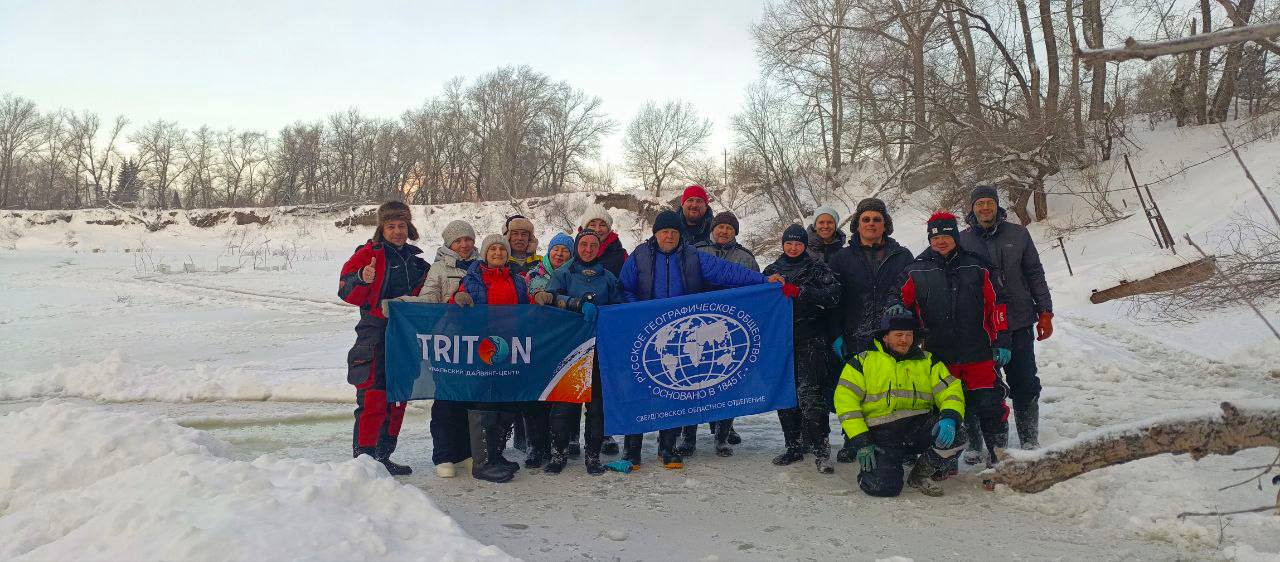

New finds telling about the distant past of our planet were brought in early January 2026 from the Tobol River by activists of the Russian Geographical Society. The paleontological expedition to the unique «bone lens» was organized by the Sverdlovsk Regional Branch of the RGS and the «Triton» dive center. The project participants performed a series of dives under the ice in extreme conditions and lifted the bones of a woolly rhinoceros, mammoth, prehistoric horse, and many other valuable specimens of ancient fauna from the bottom.
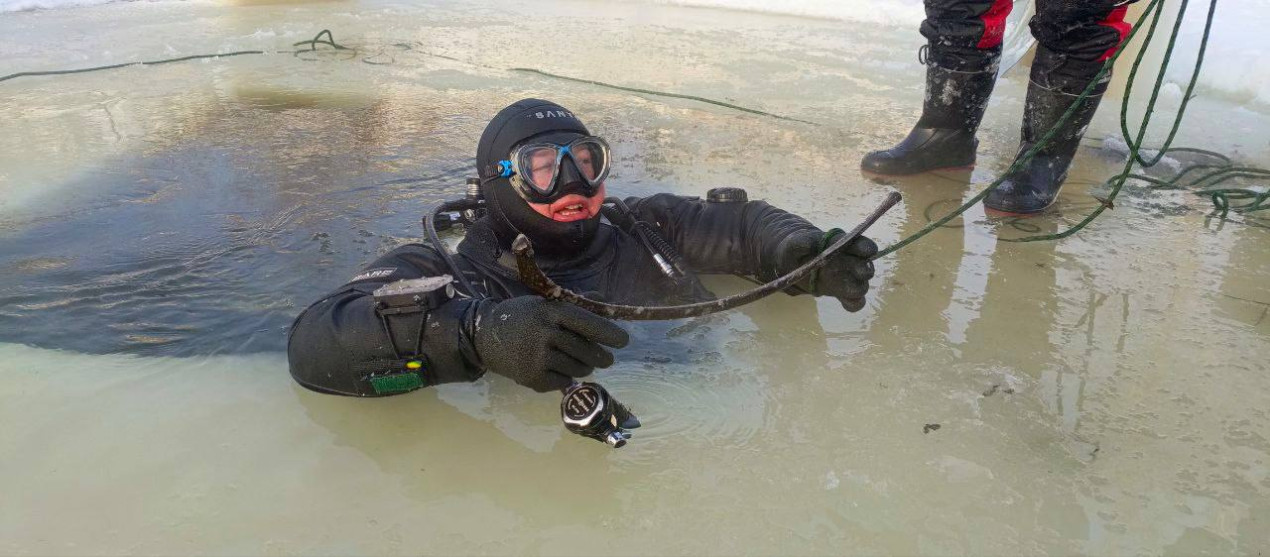
A new find has been raised from the bottom of the Tobol. Photo: Vladislav Derbyshev / Sverdlovsk Regional Branch of the RGS
Joint expeditions of the Sverdlovsk Regional Branch of the Russian Geographical Society and the «Triton» dive center have been conducted on the Tobol River in the Kurgan Region since 2004. Here, in the area of the village of Voronovka, the riverbed revealed a layer of sedimentary rocks, called the «bone lens». They store information about the times when sea waves rolled on the territory of the region, and then herds of strange animals roamed there.
Diving is traditionally carried out in winter. In more than two decades it has produced serious results. Underwater paleontologists have described previously unknown species of ancient sharks and prehistoric bison, and donated valuable exhibits to 12 museums in Russia.
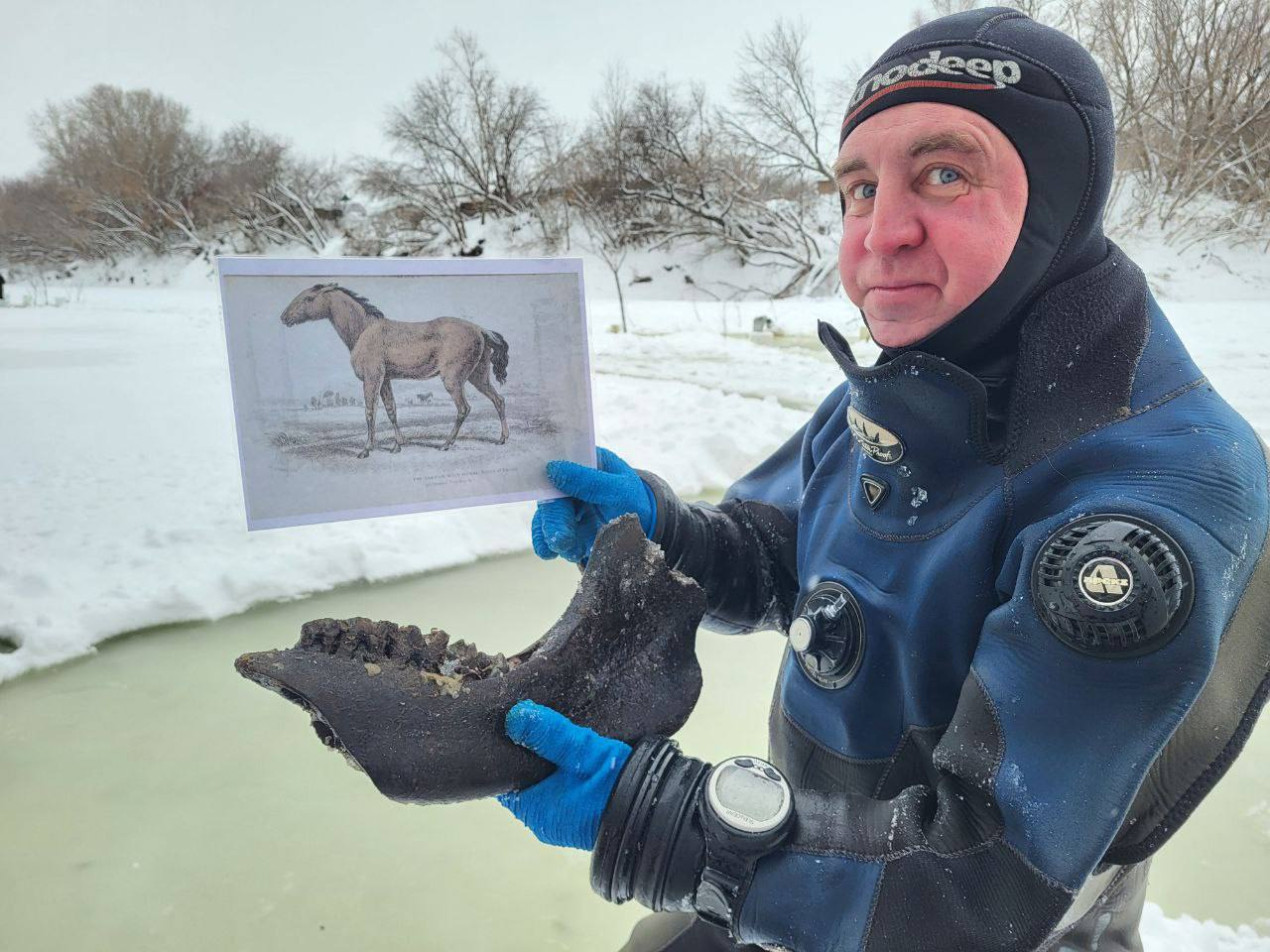
The jaw of a prehistoric horse. Photo: Vladislav Derbyshev / Sverdlovsk Regional Branch of the RGS
In January 2026, a new expedition, consisting of 25 people, went to the Tobol River. The working conditions were not the most comfortable: the water temperature was only 0,5 °C, the ice thickness was about 25 cm, and visibility under water was no more than 1–2 m. However, this did not prevent the expedition members from accomplishing all the goals.
The results of the new season are very impressive. During his first dive, Aleksey Khalyavin discovered a well-preserved jaw of an ancient horse. Then Aleksey Shcherbakov lifted a bison’s vertebra from the bottom. Konstantin Cherepennikov and Aleksandr Bespalov managed to find other bison remains and mammoth bones. Yaroslav Makarov came across the most significant find, a large fragment of the hip bone of a woolly rhinoceros, as well as its additional bones, and the remains of an ancient horse.
Divers have also collected several hundred fossilized teeth of fossil sharks and rays for scientific analysis, which may lead to the discovery of new species. All the artifacts were transferred to the paleoecology laboratory of the Institute of Plant and Animal Ecology of the Ural Branch of the Russian Academy of Sciences for detailed study, description, and professional conservation.