
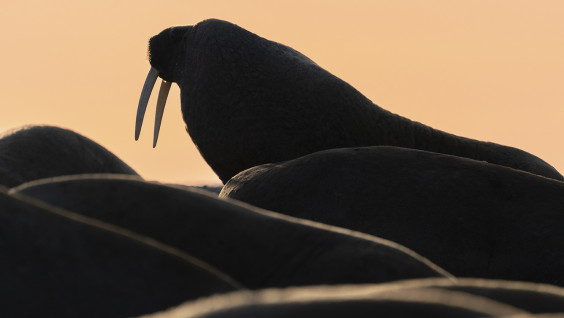

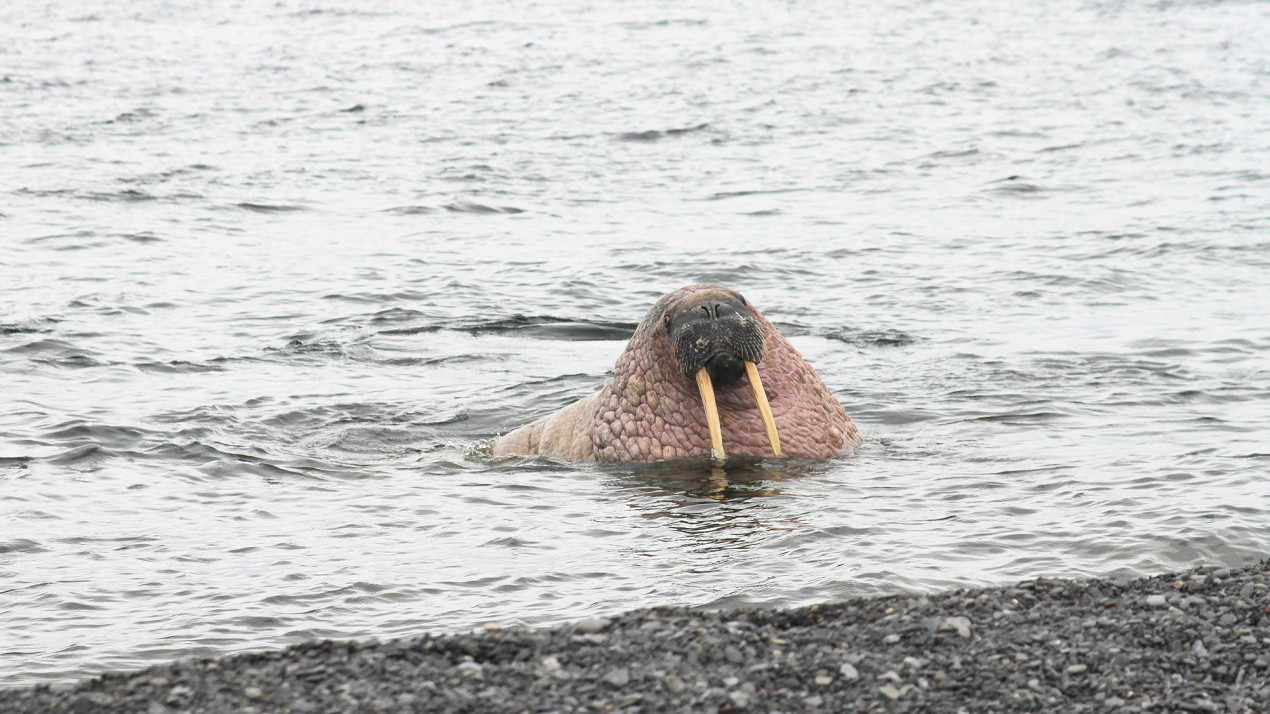
Atlantic walrus. Photo: Daria Sosina, participant of the contest "The Most Beautiful Country"
The first consolidated catalog of Atlantic walrus coastal haulouts was created thanks to the collaboration between scientists from Russia, Canada, Great Britain, Greenland, Norway, and Australia. The database contains 499 spots throughout the subspecies' range, from the coast of the Kara Sea in Russia to the Canadian Arctic.
The Atlantic walrus (Odobenus rosmarus) is listed in the Red Book of Russia as «declining in numbers» (category 2), and on the Red List of the International Union for Conservation of Nature it has the status of «near threatened» (close to vulnerable position). Walruses are a so-called indicator species that can signal changes in the state of the environment. This is especially true for the Arctic, the region most sensitive to climate change. This species of mammal is recognized as a key component of the Arctic ecosystem, and it also has important cultural and economic significance for some peoples of the North: in Canada and Greenland, indigenous people are allowed limited traditional hunting for walruses.
Climate change leads to a reduction in the area of sea ice, as a result, animals are deprived of their usual places for recreation and giving birth. In addition, the industrial development of the shelf is causing concern in their lives. Biologists note that regular monitoring of populations and regulation of hunting are critically important for the protection of the species. And for this, reliable data is needed on exactly where animals come to land.
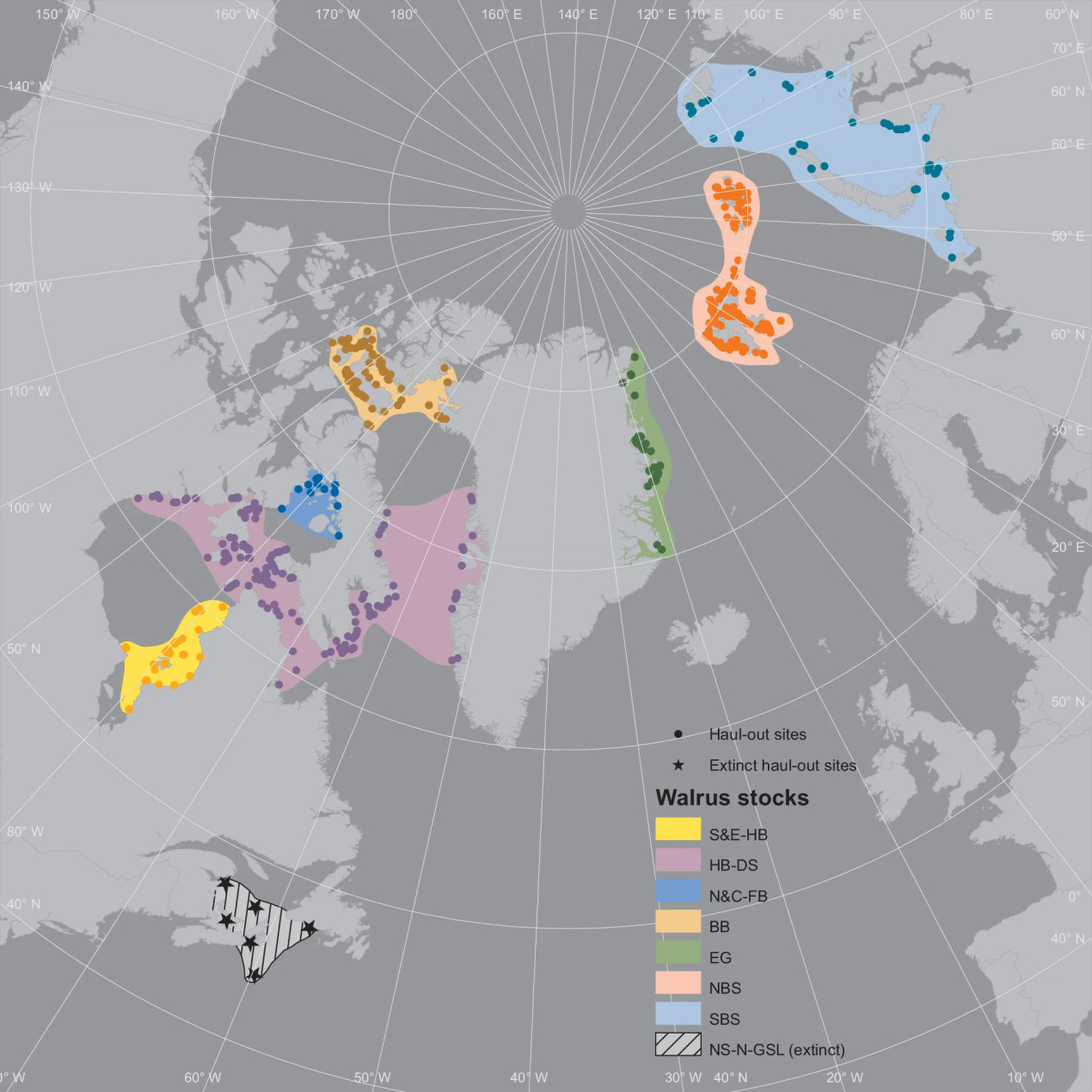
A map of Atlantic walrus populations and all its haulouts. Photo: Cubaynes, H.C., Matthews, C.J.D., Garde, E. et al. A distribution-wide dataset of Atlantic walrus terrestrial haul-out sites. Sci Data 13, 59 (2026). https://doi.org/10.1038/s41597-026-07210-6 A map of Atlantic walrus populations and all its haulouts. Photo: Cubaynes, H.C., Matthews, C.J.D., Garde, E. et al. A distribution-wide dataset of Atlantic walrus terrestrial haul-out sites. Sci Data 13, 59 (2026). https://doi.org/10.1038/s41597-026-07210-6
«The Atlantic walrus is one of the key indicators of the state of Arctic ecosystems, and it does not recognize state borders. Russian haulouts are an integral part of its range, and without taking them into account, it is impossible to get a complete picture of the population’s condition,» said Maria Gavrilo, a leading researcher at the Arctic Shelf Laboratory of the Arctic and Antarctic Research Institute (AARI), PhD in Biology, who participated in the work of an international group of researchers.
Until now, information about Atlantic walrus haulouts has been scattered: each country maintained its own databases, unrelated to each other. Scientists have combined national registries, historical records, and knowledge of indigenous peoples and, for the first time, obtained a single data set suitable for comparative analysis across the entire range, the AARI press service said.
The final database includes 499 haulouts: 237 in Canada, 125 in Norway, 86 in Russia, 51 in Greenland. Each location is described by a set of standard characteristics: coordinates, herd membership, and the degree of reliability of the data. The database is publicly available on the Arctic Biodiversity Data Service platform of the Arctic Council’s Working Group on the Conservation of Arctic Flora and Fauna (CAFF) and will be updated regularly.