
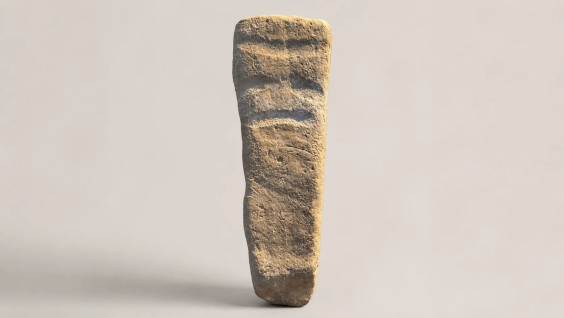

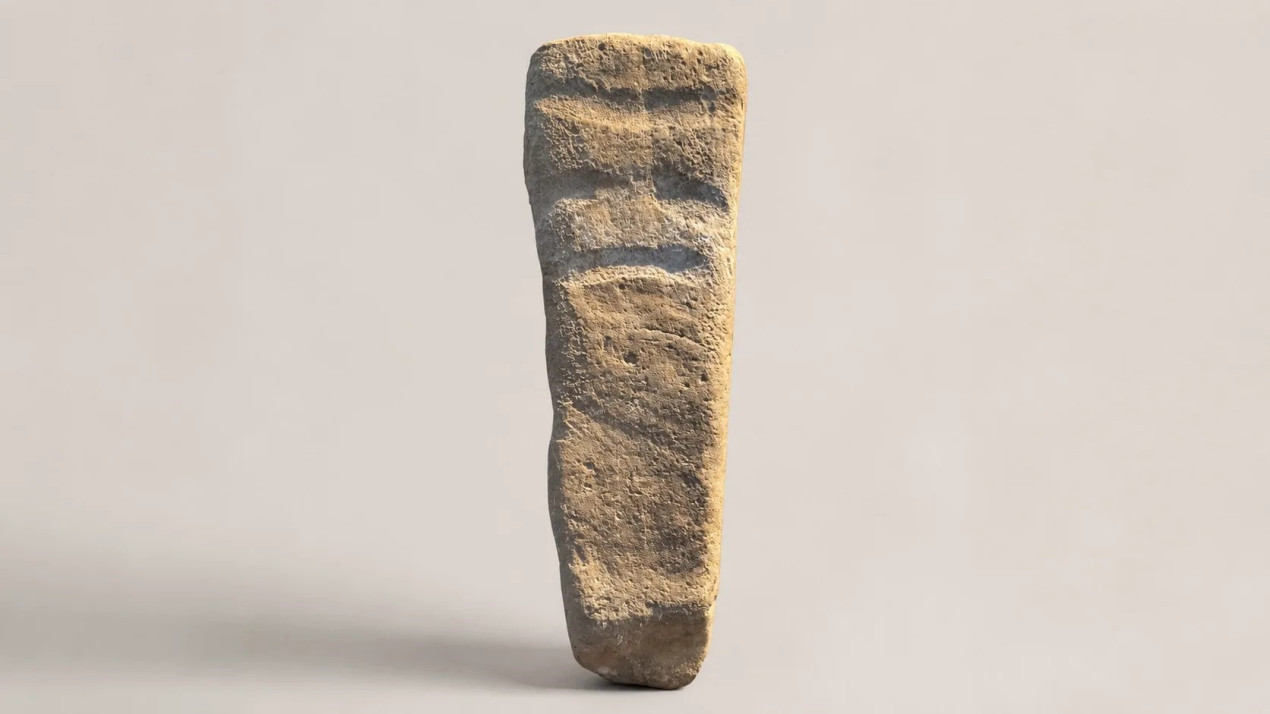
The height of the artifact is 50 cm. Image courtesy of Timur Sadykov
During the ninth season of the international archaeological expedition of the RGS and the Institute of History of Material Culture (IHMC) Russian scientists have found a stone stele on an ancient kurgan in Tuva. Experts suggest that nomadic peoples used the statue during funeral rites. Further analysis of the find will help to trace the contacts of the tribes at the beginning of the Iron Age.
Scientists discovered the artifact during the deconservation of the edges of excavations of previous years. According to the researchers, the 50-centimeter stele completely repeats the stylistic canon of a series of stone sculptures that archaeologists first discovered at Tunnug-1 five years ago. An abstract pattern of arcs and lines is carved on the front of each of them, similar to the features of a human face.
«It is surprising that such sculptures have not yet been found at other archaeological sites,» said Timur Sadykov, head of the expedition, researcher at the IHMC RAS. «If they are found outside of Tunnug-1, it will give us new evidence of nomadic tribal movements at the very beginning of the Iron Age.»
Scientists have already conducted stylistic, traceological, petrographic, and geochemical analyses of artifacts found in previous years. The results have been published in international scientific articles. Since then, the collection of finds has expanded, including the famous deer stones. They are ancient sculptures with embossed images of deer and other animals, made according to the same canon. This type is widespread not only in Tuva, but also in neighboring Mongolia.
The Tunnug-1 kurgan, located in the Piy-Khem District of the Republic of Tuva, is considered one of the oldest Scythian graves and dates back to the end of the 9th — beginning of the 8th century BC. Numerous finds from different cultures and historical eras have previously been recorded on the territory of the monument. After the field season, the stele found this year will be studied in detail in laboratory conditions.